Find Your Perfect English Learning Stack
Select your current situation below to build a personalized study plan.
Your Fluency Potential Score
Loading...
Recommended App Stack
Your Daily Routine
Most people learn English by reading grammar rules or memorizing vocabulary lists. Then they open their mouths to speak and freeze. The gap between knowing the language and actually using it is where most learners get stuck. You don't need another textbook. You need an app that forces you to produce sound, receive immediate feedback, and build confidence without the fear of judgment.
In 2026, the landscape of language learning has shifted dramatically. Artificial Intelligence has moved from a gimmick to a core teaching tool. Apps now offer personalized speech recognition that can detect subtle pronunciation errors that even human teachers might miss. But not all apps are created equal. Some focus on passive learning, while others prioritize active output. Choosing the right one depends entirely on your specific weakness: is it pronunciation, vocabulary recall, or just the sheer anxiety of talking?
The Problem with Passive Learning Apps
Many popular language apps promise fluency but deliver only familiarity. You tap screens, match pictures to words, and fill in blanks. This builds recognition, not production. When you meet a native speaker, your brain knows the word "reservation," but your mouth doesn't know how to form the sounds quickly enough. This is known as the passive-active gap.
To speak fluently, you need apps that prioritize speak English fluently through active output. These tools require you to generate sentences from scratch, respond to prompts in real-time, and engage in dialogue. If an app lets you complete a lesson without saying a single word out loud, it is likely not helping you achieve fluency. It is helping you pass a quiz. There is a big difference.
AI-Powered Speech Coaches: Your 24/7 Practice Partner
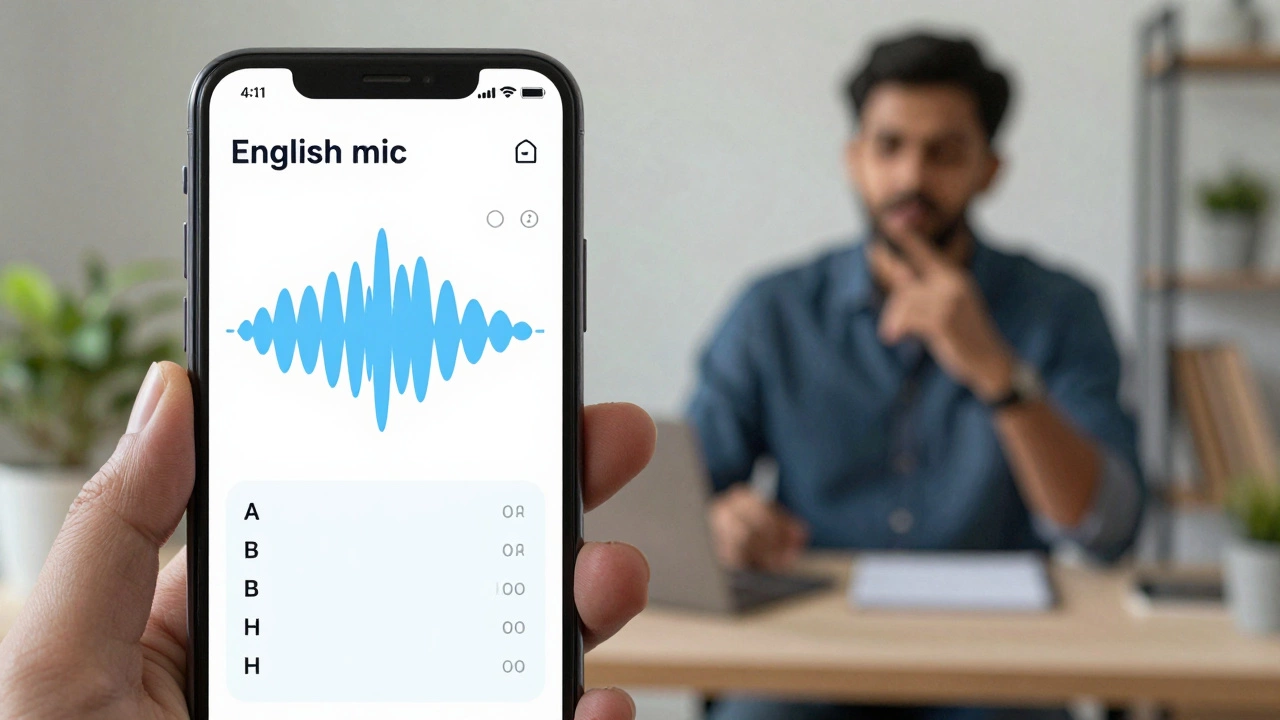
For many learners, the biggest barrier to speaking is shame. You are afraid of making mistakes in front of a teacher or a peer. AI-driven apps solve this by providing a safe, judgment-free zone. They listen to your voice, analyze your phonetics, and give instant correction.
ELSA Speak is an AI-powered English pronunciation coach that uses deep learning to identify specific sound errors. Unlike general language apps, ELSA focuses almost exclusively on accent reduction and intonation. It breaks down words into individual phonemes and shows you exactly how your tongue and lips should move. If you struggle with the "th" sound or stress patterns in long sentences, ELSA provides visual feedback that mimics a speech therapist's approach.
Another strong contender is Speechling, which combines AI transcription with human coaching. You record yourself repeating sentences from native speakers. The system compares your recording to the original and highlights differences. The unique feature here is the ability to request free feedback from certified coaches within 24 hours. This hybrid model gives you the volume of practice AI allows, with the nuance of human evaluation.
Conversation-First Platforms: Real Humans, Real Talk
AI is great for mechanics, but it cannot replicate the chaos of real conversation. Native speakers interrupt, use slang, change topics abruptly, and rely on cultural context. To bridge this gap, you need platforms that connect you with actual people.
- italki: This platform connects you with community tutors and professional teachers. You can book one-on-one video lessons tailored to your goals. Whether you want to practice business English or casual chat, you find a partner who fits your style and budget. It is less about structured curriculum and more about immersive practice.
- Tandem: This is a language exchange app. You find someone who wants to learn your native language and teaches them in exchange for English practice. It is free, but it requires effort. You must be a good teacher to be a good student. The conversations happen via text, voice notes, or video calls, mimicking real social interactions.
- Preply: Similar to italki, Preply offers flexible scheduling with vetted tutors. Their search filters allow you to find teachers specializing in specific accents (American, British, Australian) or industries (medical, legal, IT).
The key advantage here is adaptability. An AI bot will follow a script. A human will challenge you. If you say something confusing, they will ask for clarification. This negotiation of meaning is where true fluency lives.
Gamified Immersion: Building Habit Through Play
Consistency beats intensity. You are better off practicing for ten minutes every day than for two hours once a week. Gamified apps leverage psychology to keep you coming back. They use streaks, points, and leaderboards to trigger dopamine releases associated with progress.
Duolingo remains the most popular entry point for beginners. While critics argue it lacks depth, its strength lies in habit formation. Recent updates have introduced more speaking exercises and AI chatbots that simulate simple conversations. For absolute beginners who are terrified of speaking, Duolingo provides a low-stakes environment to start forming sentences aloud.
Babbel takes a more practical approach. Its lessons are built around realistic scenarios: ordering coffee, asking for directions, introducing yourself at work. Each lesson includes voice recognition technology that checks if you pronounced the phrase correctly before moving on. It bridges the gap between gamification and traditional education better than most competitors.
Contextual Learning: Shadowing and Media Integration
Fluency isn't just about correct grammar; it's about rhythm, speed, and natural flow. One effective technique is "shadowing," where you listen to a native speaker and repeat what they say simultaneously, mimicking their intonation and speed. Several apps facilitate this.
LingQ focuses on reading and listening comprehension through real-world content. You read articles, watch videos, and click on words you don't know. As your vocabulary grows, you transition from reading to speaking. The app encourages you to record your own summaries of the content, pushing you to synthesize information verbally.
Glossika uses mass sentence immersion. It feeds you hundreds of sentences daily, forcing you to repeat them until they become automatic. It relies on muscle memory rather than conscious translation. This method is intense and often frustrating, but highly effective for intermediate learners stuck in a plateau.
Comparison Table: Choosing Your Tool
| App Name | Primary Focus | Human Interaction | Best For | Cost Model |
|---|---|---|---|---|
| ELSA Speak | Pronunciation & Accent | No (AI Only) | Non-native accents, clarity | Subscription |
| italki | Conversational Fluency | Yes (Tutors) | Personalized feedback, motivation | Pay-per-lesson |
| Speechling | Imitation & Feedback | Hybrid (AI + Human) | Specific sentence structures | Freemium |
| Tandem | Language Exchange | Yes (Peers) | Cultural exchange, casual chat | Free/Premium |
| Babbel | Practical Phrases | No (AI Voice Recog) | Beginners, travel prep | Subscription |
How to Combine Apps for Maximum Results
Relying on a single app rarely leads to fluency. Think of these tools as instruments in an orchestra. You need different ones for different jobs. A successful strategy often involves a combination:
- Foundation (Daily): Use a gamified app like Babbel or Duolingo for 10-15 minutes to maintain vocabulary and grammar habits.
- Precision (3x Week): Spend 10 minutes on ELSA Speak or Speechling to drill difficult sounds and improve pronunciation accuracy.
- Application (Weekly): Book one 30-minute session on italki or Tandem to use what you've learned in a real conversation. Discuss a topic you studied in your other apps.
This multi-pronged approach ensures you are building knowledge, refining mechanics, and applying skills in context. It prevents burnout by varying the type of mental effort required each day.
Pitfalls to Avoid
Even with the best apps, you can fail to improve if you fall into common traps. First, avoid the "passive listener" trap. Listening to podcasts or watching videos without active participation does little for speaking ability. You must produce sound. Second, don't ignore feedback. If an app marks your pronunciation as incorrect, do not skip it. Repeat the exercise until you understand why it was wrong. Third, consistency matters more than duration. Five minutes of focused speaking practice every day is superior to an hour of distracted study once a week.
Finally, remember that fluency is not perfection. Native speakers make grammatical errors, mumble, and use filler words. Your goal is communication, not robotic accuracy. Choose an app that encourages you to keep talking, even when you make mistakes.
Which app is best for complete beginners?
For absolute beginners, Babbel or Duolingo are excellent starting points. They provide structured lessons that introduce basic vocabulary and simple sentence structures. Babbel is slightly better for practical usage, while Duolingo is better for building a daily habit through gamification. Both include basic voice recognition features to help you start speaking early.
Can AI apps really replace human teachers?
AI apps cannot fully replace human teachers, especially for advanced learners. AI is superior for drilling pronunciation, grammar rules, and vocabulary retention because it offers instant, unlimited feedback. However, humans are essential for nuanced conversation, cultural context, and emotional support. A hybrid approach using both AI for practice and humans for conversation yields the best results.
How much time should I spend on speaking apps daily?
Aim for at least 15-20 minutes of active speaking practice daily. Consistency is more important than duration. Short, frequent sessions help reinforce neural pathways associated with language production. Try to integrate speaking practice into existing routines, such as during your commute or while having breakfast.
Are free apps effective for achieving fluency?
Free apps like Tandem or the free tiers of Speechling can be effective if you are disciplined. They provide access to native speakers and basic feedback tools. However, premium features often offer more structured lessons, detailed analytics, and unlimited practice. Free apps require more self-motivation and planning to ensure comprehensive coverage of language skills.
What is the best app for improving my accent?
ELSA Speak is widely considered the best app for accent reduction. It uses advanced AI to analyze your speech at the phoneme level, identifying specific errors in vowel sounds, consonants, and intonation. It provides visual guides and repetitive drills to help you master the physical movements required for clear English pronunciation.