IIT Bombay Admission Probability Calculator
Admission Analysis
Based on historical closing ranks for General Category (adjusted estimates for others).
| Branch | Closing Rank Limit | Probability |
|---|
Strategic Advice
Enter your details to see your chances of securing a seat at IIT Bombay across different branches.
Getting into IIT Bombay is one of the most difficult academic challenges in India, requiring a rank in the top 0.1% of over a million students who take the JEE Advanced exam every year. If you are asking how hard it is, the short answer is: brutally hard. But the long answer involves understanding exactly what that difficulty looks like in numbers, strategy, and mental endurance.
You aren't just competing against your classmates. You are competing against the brightest minds from across the country. To get a seat here, you need to clear two massive hurdles: JEE Main is the first stage screening test conducted by NTA, where you need to be in the top 250,000 to qualify for the next round and then JEE Advanced is the final selection exam conducted by IITs, known for its complex, multi-concept questions that test deep understanding rather than rote learning. Let’s break down why this path is so steep and what it actually takes to climb it.
The Numbers Behind the Difficulty
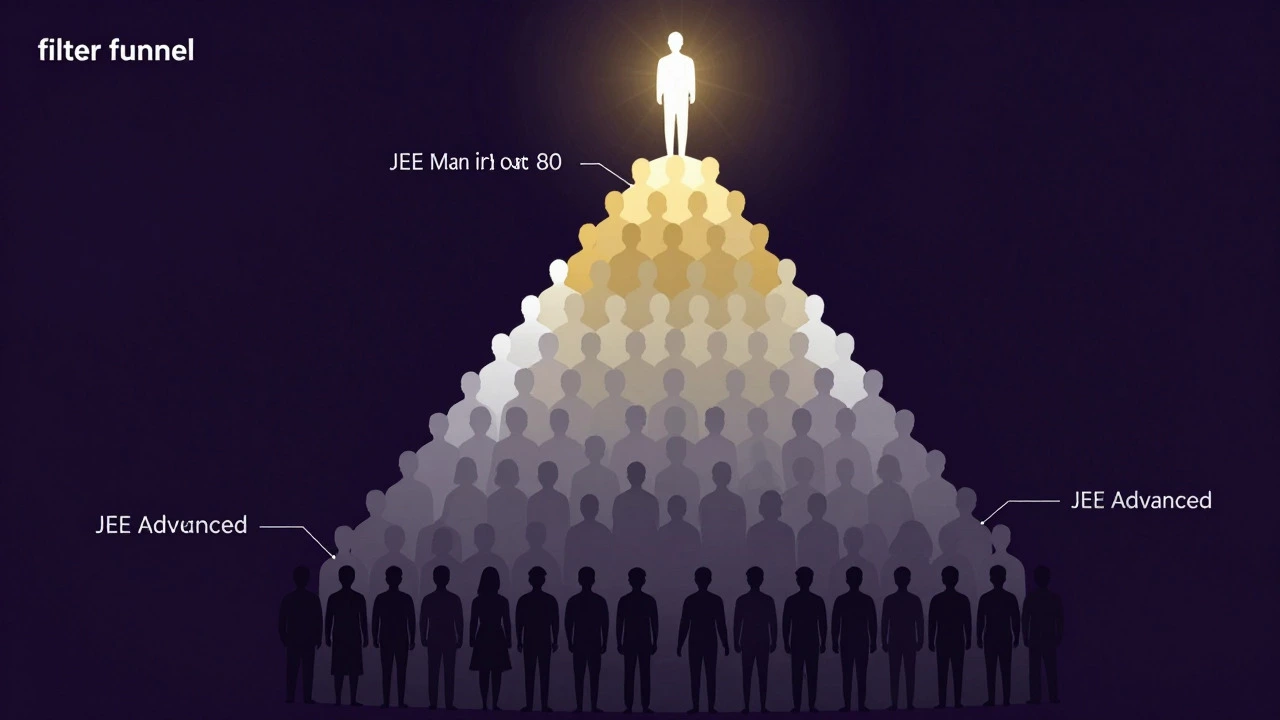
To understand the scale, look at the funnel. Every year, roughly 1.2 to 1.4 million students register for JEE Main. Only about 250,000 of them qualify for JEE Advanced. That means 80% of aspirants are filtered out before they even see the second paper. Then, among those 250,000, only around 17,000 to 18,000 get seats in all the IITs combined.
IIT Bombay offers approximately 1,100 to 1,200 seats across various branches like Computer Science, Electrical Engineering, Mechanical, and Civil. For the most sought-after branch, Computer Science and Engineering (CSE), the closing rank for General category candidates usually hovers between 150 and 300. This means if you score outside the top 300 ranks nationwide, getting CSE at IIT Bombay is statistically nearly impossible unless you have specific reservation benefits.
| Branch | Estimated Seats | Closing Rank Range |
|---|---|---|
| Computer Science & Engineering | ~160 | 150 - 350 |
| Electrical Engineering | ~120 | 400 - 900 |
| Mechanical Engineering | ~180 | 800 - 1,500 |
| Civil Engineering | ~100 | 1,200 - 2,500 |
| Chemical Engineering | ~100 | 1,500 - 3,000 |
These numbers change slightly every year based on question difficulty and the number of applicants, but the trend remains consistent: the top tier is incredibly crowded. The competition isn't just about knowing the syllabus; it's about executing under extreme pressure with near-perfect accuracy.
Why JEE Advanced Is Different From Other Exams
If you think clearing board exams or even JEE Main prepares you for JEE Advanced, you might be in for a shock. JEE Advanced pattern is designed to differentiate the very best students through unconventional question types, negative marking strategies, and multi-correct options. In JEE Main, you can often solve problems using standard formulas. In JEE Advanced, the formula might not work directly, or there might be three different ways to approach a problem, each taking a different amount of time.
The exam tests three core subjects: Physics, Chemistry, and Mathematics. However, the depth required is immense. For example, in Physics, you won't just calculate force; you'll analyze complex systems involving rotational dynamics coupled with electromagnetism. In Chemistry, organic mechanisms require visualizing 3D structures and predicting reaction pathways without memorization. In Mathematics, calculus and algebra problems often involve multiple steps where a small error early on ruins the entire solution.
This shift from "knowing" to "applying creatively" is what makes the exam so hard. Many students who score 95+ percentile in JEE Main find themselves struggling to crack the top 1% in JEE Advanced because their preparation was too focused on speed and pattern recognition rather than conceptual clarity.
The Mental Game: Stress and Burnout
Let’s talk about something rarely mentioned in coaching brochures: the psychological toll. Preparing for IIT Bombay is a marathon, not a sprint. Most serious aspirants spend two years in dedicated coaching classes, studying 12-14 hours a day. The pressure comes from parents, peers, and self-expectation.
Burnout is real. Around the middle of the second year, many students hit a wall. Their mock test scores plateau or drop despite working harder. This is where resilience matters more than intelligence. Successful candidates aren't necessarily the smartest kids in the room; they are the ones who can bounce back after a bad mock test, analyze their mistakes without losing confidence, and keep going.
You need to build emotional stability alongside your academic knowledge. Taking breaks, maintaining hobbies, and talking to mentors are not distractions-they are essential parts of the strategy. If you burn out six months before the exam, all your hard work goes to waste.
Strategic Preparation: What Actually Works
So, how do you navigate this minefield? Here is a realistic approach used by successful candidates:
- Master NCERT First: Especially for Chemistry and Biology-related parts of Physics, the National Council of Educational Research and Training (NCERT) textbooks are the bible. Don't skip them for advanced books immediately. Build a rock-solid foundation.
- Focus on Concepts, Not Tricks: Shortcuts help in JEE Main, but in JEE Advanced, concepts save you. Understand why a theorem works, not just how to apply it. Books like HC Verma for Physics and RD Sharma for Math are classics for a reason.
- Mock Tests Are Non-Negotiable: Start taking full-length mock tests early. Analyze every mistake. Was it a calculation error? A concept gap? Or poor time management? Keep an error log. Review it weekly.
- Time Management During Exam: JEE Advanced has a unique interface where you can switch between papers. Learn to allocate time wisely. Sometimes, leaving a tough question and coming back later is smarter than staring at it for 20 minutes.
- Consistency Over Intensity: Studying 10 hours daily for 365 days is better than studying 16 hours for 100 days and then burning out. Regular revision is key to retaining information.
Is It Worth It? Weighing the Pros and Cons
Before you dive headfirst, ask yourself: Why do you want to get into IIT Bombay? The brand value is undeniable. Alumni networks are powerful, placement packages are among the highest in the country, and the learning environment is stimulating. But consider the cost.
The opportunity cost is high. You sacrifice social life, hobbies, and sometimes mental health for two years. And even if you don't get into IIT Bombay, does it mean failure? Not necessarily. There are other excellent institutes like IIIT Hyderabad, NIT Trichy, or BITS Pilani that offer great education and careers. However, if your heart is set on IIT Bombay, you need to accept that rejection is part of the process. Many toppers don't get their first choice due to minor fluctuations in performance.
Also, remember that success in life doesn't depend solely on your college tag. Skills, adaptability, and continuous learning matter more in the long run. IIT Bombay gives you a head start, but it doesn't guarantee lifelong success. You still have to work hard after graduation.
Common Mistakes Aspirants Make
Avoid these pitfalls to stay on track:
- Ignoring Weak Subjects: Don't focus only on your strong subject. If you are good at Math but weak in Chemistry, balance your effort. JEE Advanced requires competence in all three.
- Overloading with Resources: Having 10 books for one subject is counterproductive. Stick to 2-3 quality resources per subject and master them.
- Neglecting Health: Sleep deprivation kills productivity. Aim for 6-7 hours of sleep. Exercise regularly to keep stress levels in check.
- Comparing Yourself to Others: Everyone has a different pace. Focus on your own progress. Comparing ranks with friends adds unnecessary anxiety.
Final Thoughts on the Journey
Getting into IIT Bombay is hard. It demands discipline, intelligence, and grit. But it is not impossible. Thousands do it every year. The key is to start early, prepare smartly, and maintain your mental health. Treat the journey as a learning experience, regardless of the outcome. Whether you land up in IIT Bombay or another institute, the skills you develop during this preparation will serve you well throughout your career.
What is the average rank needed for IIT Bombay?
For General category candidates, a rank under 300 is typically required for Computer Science, while ranks up to 2,500 may secure seats in other branches like Civil or Chemical Engineering. Reserved categories have higher cutoff ranks.
Can I prepare for JEE Advanced without coaching?
Yes, self-study is possible with disciplined planning, quality study materials, and regular mock tests. However, coaching provides structure, peer competition, and expert guidance which many find helpful.
How many hours should I study daily?
Most successful aspirants study 10-12 hours a day, including school/coaching time. Quality of study matters more than quantity. Ensure breaks and adequate sleep to maintain focus.
Is JEE Advanced harder than JEE Main?
Yes, significantly. JEE Main tests breadth and speed, while JEE Advanced tests depth, creativity, and application of concepts in novel situations. Questions are more complex and multi-layered.
What happens if I miss IIT Bombay but qualify for other IITs?
You can choose from other IITs during counseling. Many IITs offer excellent education and placements. Alternatively, you can drop a year to retry if you feel you performed below potential.