Government Job Eligibility Checker
Find the best government job exams for your profile based on your education, location, and career goals. This tool will recommend exams that match your background and help you avoid common mistakes like chasing the wrong exam.
Recommended Government Exams
Your Best Matches
Why these matches?
Getting a job in government isn’t about knowing the right person or luck-it’s about strategy, timing, and knowing exactly what to study. Every year, over 20 million people in India alone apply for government positions. Less than 2% get hired. Why? Because most people start at the wrong place. They chase the biggest exam without understanding the system. If you want a stable, secure career in government, you need a clear roadmap-not a wish list.
Understand the Types of Government Jobs
Not all government jobs are the same. There are three main tiers: central, state, and local. Each has different exams, pay scales, and responsibilities.
- Central government jobs include positions like IAS, IPS, IRS, RBI Grade B, SSC CGL, and UPSC ESE. These are competitive, national-level roles with higher pay and mobility.
- State government jobs cover state PCS, state police, teachers, and revenue officers. These are easier to crack than central exams and often have lower competition ratios.
- Local government jobs include municipal corporation roles, village-level panchayat positions, and district-level clerks. These are entry-level but offer quick hiring cycles.
Most people jump straight into UPSC without checking if they even qualify. You need a bachelor’s degree for most central jobs. For state-level roles, sometimes a 12th pass is enough. Know your eligibility before you start studying.
Choose the Right Exam for Your Profile
Don’t copy what your friend is doing. Your background, location, and goals matter.
If you’re from a small town with limited resources, start with state-level exams like UPPSC, BPSC, or MPSC. These have fewer applicants and more regional language options. If you’re in a metro city and fluent in English, go for SSC CGL or RBI Grade B-they’re faster to crack and pay well from day one.
Here’s a quick match:
- Engineering graduate? Try UPSC ESE or SSC JE. Your technical skills give you an edge.
- Commerce or accounting background? Look at SSC CGL (Auditor, Accountant), RBI Grade B, or State Tax Inspector roles.
- Arts or humanities? UPSC Civil Services (IAS/IPS) or State PCS are your best bets.
- Just passed 12th? Start with SSC CHSL or RRB Group D. These are stepping stones.
Many people waste two years preparing for UPSC when they’d have gotten a job faster by targeting SSC CGL first. There’s no shame in starting small. The goal isn’t to be an IAS officer tomorrow-it’s to get a government job, period.
Study Smart, Not Hard
Government exams don’t test how much you memorize. They test how well you apply basic knowledge under pressure.
For example, the SSC CGL General Awareness section has 25 questions. Around 15 of them come from current affairs of the last 6 months. The rest? Indian Polity, History, Geography, and Science-basic topics covered in NCERT books from Class 6 to 10. You don’t need to read 20 books. You need to read the right 3.
Here’s what actually works:
- Start with NCERTs (Class 6-10) for History, Geography, Polity, and Science. Skip Class 11-12 unless you’re aiming for UPSC.
- Use Lucent’s General Knowledge for quick revision. It’s updated yearly and covers 90% of what’s asked.
- Follow one reliable current affairs source-like The Hindu or PIB-for 20 minutes a day. Don’t collect 50 apps.
- Practice math and reasoning daily. Use previous year papers. Don’t buy new books every month.
Most aspirants fail because they study randomly. They read 100 pages and forget 90. Instead, read 10 pages, test yourself, and move on. Retention beats volume.
Build a Realistic Timeline
There’s no magic 6-month plan. Your timeline depends on your starting point.
If you’re a graduate with no exam experience:
- Months 1-3: Learn the exam pattern. Solve 5 past papers. Identify your weak areas.
- Months 4-6: Build core knowledge. Finish NCERTs. Start daily current affairs.
- Months 7-9: Focus on practice. Take weekly mocks. Analyze every mistake.
- Months 10-12: Revise. Focus on speed. Apply for exams.
If you’re already working or studying:
- Study 90 minutes a day. That’s 10.5 hours a week.
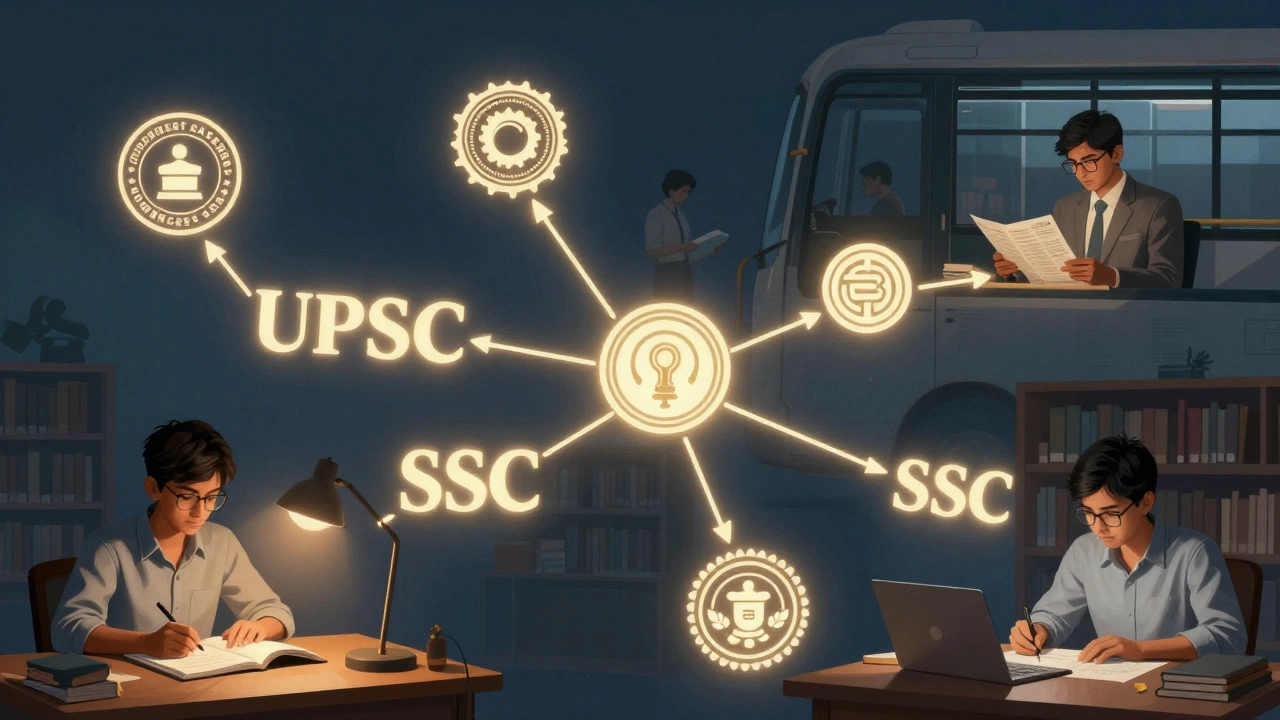
- Use commute time to listen to current affairs podcasts.
- Schedule one full mock test every 15 days.
Consistency beats cramming. Someone who studies 1 hour a day for a year will outperform someone who studies 10 hours a week for 2 months and then quits.
Apply Like a Pro
Most candidates lose because they miss deadlines or fill forms wrong.
Here’s how to avoid that:
- Bookmark the official websites: UPSC, SSC, IBPS, RBI, and your state’s PSC portal.
- Set Google Alerts for “government jobs [your state]” or “SSC notification 2025”.
- When a notification drops, read it three times. Check: age limit, educational qualification, application fee, exam date, and required documents.
- Don’t wait for the last day. Apply 7 days before the deadline. Websites crash.
- Save scanned copies of your photo, signature, ID, and degree in advance. Use 200KB size, JPEG format.
Last year, over 1.2 million applicants were disqualified for uploading blurry photos or wrong signatures. That’s avoidable.
Prepare for the Interview
Many people clear written exams but fail interviews. Why? They think it’s about sounding smart.
It’s not. Interviewers want to know if you’re honest, calm, and grounded.
Here’s what works:
- Know your own resume. If you wrote “volunteered at a local NGO,” be ready to talk about what you did, how many hours, and what you learned.
- Be ready for questions like: “Why do you want a government job?” Don’t say “for job security.” Say: “I want to serve my community. I saw how a local Panchayat improved water access in my village, and I want to be part of that change.”
- Practice with friends. Record yourself. Watch how you sit, speak, and react.
- Dress simply. No suits unless it’s IAS interview. A clean shirt and trousers are enough.
One candidate cleared UPSC with a 7th rank. His interview score was the highest because he talked about his father’s small shop and how he wanted to improve rural business policies. He didn’t quote the Constitution-he told a story.
Avoid These 5 Deadly Mistakes
These are the top reasons people fail:
- Chasing the dream job first. Don’t start with UPSC if you’re 22 and have no background. Start with SSC CHSL or state clerk jobs. Get experience.
- Buying too many books. You don’t need 50 books. You need 3 good ones and 2 years of practice.
- Ignoring current affairs. 30-40% of questions come from the last 6-12 months. Skipping this is like walking into an exam blindfolded.
- Not taking mocks seriously. If you score 120/200 in a mock, you won’t get 180 in the real exam. Mocks reveal your real level.
- Giving up after one failure. The average UPSC topper takes 3-4 attempts. Don’t quit after the first try. Analyze, adjust, try again.
What Comes After You Get the Job?
Getting the job is just the start. Once you’re in, you’ll need to learn the rules, handle paperwork, deal with bureaucracy, and sometimes work in remote areas.
But here’s the truth: government jobs give you something no private job can-stability. Your salary won’t double in five years, but it won’t vanish either. You’ll get pensions, medical benefits, paid leaves, and job security even during recessions.
And if you’re patient, you’ll rise. Many IAS officers started as clerks. Many IPS officers began as constables. Progress isn’t fast, but it’s real.
Start today. Pick one exam. Read one NCERT. Solve one previous paper. That’s all you need to begin.
Can I start preparing for government jobs after graduation?
Yes, absolutely. Most government exams require a bachelor’s degree, so graduation is the perfect starting point. Many successful candidates begin preparing right after college. Focus on one exam at a time, like SSC CGL or state PCS, and build your knowledge step by step.
Is coaching necessary for government job exams?
No, coaching isn’t necessary. Many toppers have cleared exams without coaching. What matters is discipline, access to the right study material, and consistent practice. If you can’t afford coaching, use free resources like YouTube channels, government portals (PIB, NCERT), and previous year papers. Self-study works if you’re consistent.
How many attempts are allowed for government exams?
It varies by exam and category. For UPSC Civil Services, general category candidates get 6 attempts until age 32. OBC candidates get 9 attempts until age 35. SC/ST candidates have unlimited attempts until age 37. For SSC CGL, there’s no fixed limit-you can apply as long as you meet the age criteria. Always check the official notification before applying.
What’s the best age to start preparing for government jobs?
There’s no perfect age. Many start in college, but others begin after working in the private sector. The key is readiness-not age. If you’re 20 and focused, you’re ahead of someone who’s 25 but distracted. Start when you’re mentally prepared to commit for 1-2 years.
Can I prepare for government exams while working a full-time job?
Yes, many people do. You’ll need to manage time tightly-study 1-1.5 hours daily, use weekends for mocks, and prioritize high-yield topics like current affairs and reasoning. It’s harder, but not impossible. The key is consistency. Even 30 minutes a day adds up to 18 hours a month.
Are government jobs better than private sector jobs?
It depends on what you value. Government jobs offer job security, pensions, medical benefits, and work-life balance. Private jobs offer faster promotions, higher salaries, and more innovation. If you want stability and a predictable life, government is better. If you want rapid growth and risk, private sector might suit you better. Neither is superior-it’s about your personal goals.
Next Steps: Your 7-Day Action Plan
Here’s what to do right now:
- Day 1: Pick one exam (e.g., SSC CGL or your state PCS).
- Day 2: Download the official notification and check eligibility.
- Day 3: Get one NCERT book (Class 9 or 10 History/Polity).
- Day 4: Solve one previous year’s question paper. Don’t worry about marks-just see the pattern.
- Day 5: Subscribe to one current affairs source (e.g., PIB website).
- Day 6: Create a study schedule-2 hours a day, 6 days a week.
- Day 7: Tell someone your plan. Accountability keeps you going.
Don’t wait for the perfect time. Start now. One step today beats a hundred plans tomorrow.