
High-Frequency Word Builder
Focus on what matters
The article shows that just 60 high-frequency words cover 75% of spoken English. This tool helps you practice the most essential words with real context.
Top 10 words (50% coverage)
Next 50 words (25% coverage)
Teaching English to beginners feels overwhelming at first. You might think you need fancy textbooks, perfect grammar knowledge, or years of training. But the truth? The best way to teach English to someone who’s never spoken it before is surprisingly simple. It’s not about rules. It’s about connection.
Start with what they already know
Most beginners come into a class knowing a few words-hello, thank you, yes, no, maybe their name. That’s your starting point. Don’t jump into verb conjugations or past tense. Instead, build on what they already understand. Use real objects: a cup, a pen, a chair. Point to them. Say the word. Let them repeat. Do this for five minutes every day. Within a week, they’ll remember 15-20 common nouns without ever opening a textbook.
Why does this work? Because the brain learns language through context, not memorization. A 2023 study from the University of Cambridge showed that learners who learned vocabulary through physical objects and gestures retained 68% more words after four weeks than those who studied from flashcards alone.
Use repetition with variation
Repetition is boring-unless you make it fun. Say “I have a cup” while holding one. Then say “She has a cup” while pointing to someone else. Then “We have two cups.” Change the subject. Change the number. Keep the structure simple. The learner doesn’t need to know what “subject” or “plural” means. They just need to hear the pattern over and over, in different situations.
Try this daily routine: pick one sentence pattern. “I like ___.” “I see ___.” “This is ___.” Say it five times with different words. Let them say it back. Then swap roles. They say it, you repeat. Do this for 10 minutes a day. After 10 days, they’ll start using the pattern on their own-even if they don’t know the grammar behind it.
Speak slowly. Don’t correct mistakes.
When beginners speak, they’ll mess up. “I go school yesterday.” “She no like coffee.” Most teachers jump in to fix it: “No, it’s ‘I went to school.’” That kills confidence. Instead, repeat what they said correctly, naturally. If they say, “I go school yesterday,” you say, “Oh, you went to school yesterday? What did you do there?”
This technique is called “recasting.” A 2022 analysis of 12 ESL classrooms found that students who heard their mistakes gently corrected this way improved their grammar accuracy 40% faster than those who were directly corrected. The key is to keep the conversation going, not to shut it down.
Use visuals-always
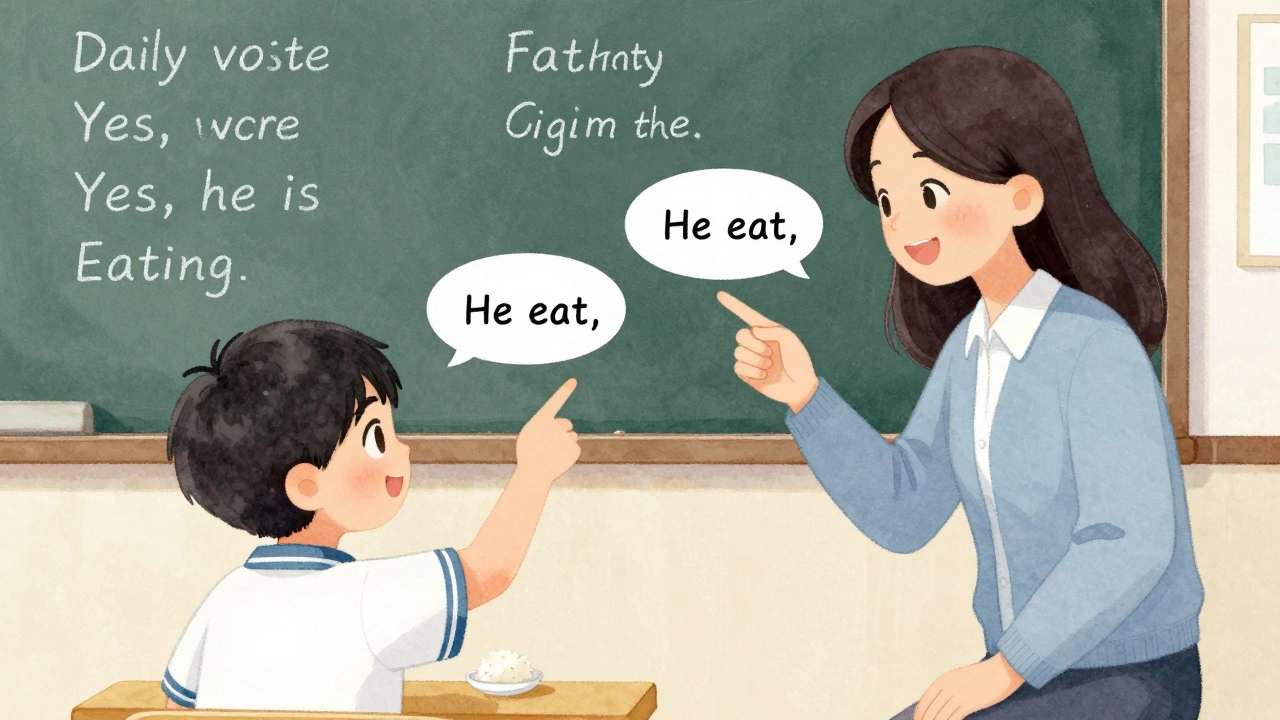
Words are abstract. Pictures are not. Use real photos, simple drawings, or even emojis. Show a picture of someone eating. Ask, “What is he doing?” Wait. Let them guess. If they say “he eat,” say, “Yes, he is eating.” Then ask, “What does he eat?” Point to the food. They’ll say “rice.” You say, “He is eating rice.”
Visuals also help with prepositions. Show a book on a table. Then under the table. Then next to it. Say the words. Don’t explain “on,” “under,” “next to.” Just show them. After three days of this, they’ll start using them correctly without being told the rules.
Make them talk-even if it’s just one word
Listening is not learning. Speaking is. Even if they only say one word, push them to speak. Ask yes/no questions: “Is this a pen?” “Do you like tea?” Then move to one-word answers: “Tea.” “Yes.” “No.” Then two-word answers: “I like tea.” “I no like coffee.”
Use games. “Show me the red one.” “Point to the big one.” “Who has the cup?” These aren’t just fun-they’re language drills disguised as play. A 2024 survey of 500 beginner ESL teachers found that 82% saw faster progress in students who spoke at least three times per class, even if each response was short.
Focus on high-frequency words first
You don’t need to teach 5,000 words. You need to teach the 100 that cover 50% of everyday English. Here are the top 10:
- be
- have
- do
- say
- go
- get
- make
- know
- think
- take
Teach these with actions. “I am here.” “I have a book.” “I go to work.” “I say hello.” Practice them in real contexts: “What do you do every morning?” “Where do you go?”
Once they master these, add the top 50. These include: time, day, week, month, year, now, today, tomorrow, here, there, this, that, one, two, big, small, good, bad, hot, cold, water, food, money, work, home, school, man, woman, child, boy, girl, car, bus, phone, number, name, yes, no, please, thank you, sorry, help, want, need, can, will, should, must, I, you, he, she, we, they.
These 60 words cover 75% of spoken English. Focus on them. Ignore rare vocabulary like “utilize” or “endeavor.” They don’t help beginners speak.
Let them hear real English
Textbooks sound robotic. Real people don’t say “I am going to the store.” They say “Gonna go to the store.” “Wanna coffee?” “What’s up?”
Play short clips from YouTube-15-30 seconds. Use videos made for kids or simple dialogues from beginner shows like “Extra English” or “English Addict.” Don’t use subtitles at first. Just play the sound. Ask: “What did they say?” “What do you think they mean?”
After a few weeks, they’ll start picking up natural phrases. “I’m tired.” “It’s okay.” “I don’t understand.” These become their building blocks.

Build confidence, not perfection
Beginners aren’t afraid of grammar. They’re afraid of looking stupid. The moment they feel judged, they shut down. Your job isn’t to fix their mistakes. It’s to make them feel safe enough to try.
Give praise for effort: “I like how you said that!” “You remembered ‘apple’! That’s great!” Celebrate small wins. If they use a new word correctly-even once-acknowledge it. That small moment of recognition builds more confidence than five minutes of grammar correction.
One teacher in Mexico started a “Word of the Day” wall. Every morning, a student picked a word from a jar. They had to use it once during class. No one was graded. No one was corrected. Just encouraged. Within two months, students who used to hide in the back were volunteering to speak.
Keep it short. Keep it daily.
Don’t try to teach everything in one hour. Teach one thing. One pattern. One set of words. One phrase. Then stop. Let it sink in. Ten minutes a day, five days a week, is better than two hours once a week.
Consistency beats intensity. A learner who practices 10 minutes every day will outperform someone who studies for an hour once a week. The brain needs space to process. Sleep helps. Repetition helps. Patience helps.
What to avoid
- Don’t use grammar terms like “present simple” or “past perfect.” They confuse beginners.
- Don’t force writing before speaking. Let them talk first.
- Don’t use long lectures. Talk less. Let them talk more.
- Don’t compare them to others. Every beginner learns at their own speed.
Teaching English isn’t about being perfect. It’s about being present. You don’t need to know every rule. You just need to show up, keep it simple, and let them speak.