Coding Journey Timeline Calculator
How long until you're coding comfortably?
Based on your consistent daily practice, we'll estimate when you'll reach key milestones.
Many people wonder if coding is hard for beginners. The truth? It’s not about being smart or having a math degree. It’s about patience, practice, and knowing where to start. If you’ve ever felt overwhelmed by the idea of writing lines of code, you’re not alone. Thousands of people start coding every month-some quit after a week, others stick with it and land jobs in tech without any prior experience. What’s the difference? It’s not talent. It’s strategy.
What does coding actually feel like on day one?
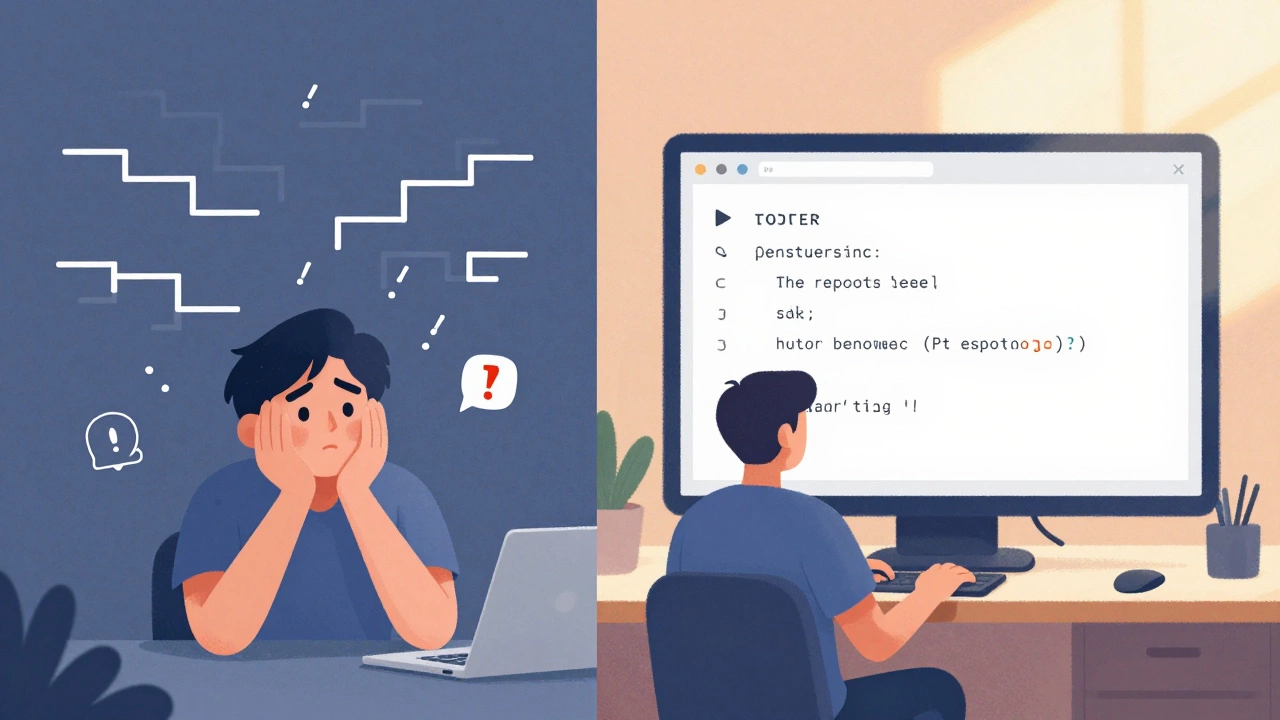
Imagine trying to bake a cake without ever seeing a recipe. That’s what coding feels like at first. You open a blank screen, read a tutorial that says, “Type this: print(‘Hello World’),” and suddenly you’re stuck. Why does it need parentheses? Why not a semicolon? Why does it say “error” when you did exactly what it said?
That’s normal. The first few days are about confusion, not mastery. You’re not learning to code-you’re learning how to think like a computer. Computers don’t understand “kinda,” “maybe,” or “you know what I mean.” They need exact instructions. So when your code doesn’t run, it’s not because you’re bad at it. It’s because you missed a comma, used the wrong capital letter, or forgot to close a bracket. These aren’t mistakes that mean you’re unfit for coding. They’re part of the process.
Most beginners quit because of the wrong expectations
People think coding is like learning to play the piano-practice for hours, then suddenly you’re performing Mozart. But coding is more like learning to drive. At first, you’re scared of the pedals. Then you forget to check mirrors. Then you stall the car. But after a few weeks, it becomes automatic. You don’t think about shifting gears-you just do it.
The problem? Most beginners expect to build an app in a weekend. They watch YouTube videos of developers creating websites in 10 minutes, then feel like failures when their own code breaks after five lines. That’s not reality. Those videos are edited highlights. Real coding is messy. It’s debugging for hours. It’s Googling the same error 12 times. It’s rewriting the same function three times because the first two didn’t work.
If you’re not prepared for that, you’ll quit. But if you know it’s supposed to feel hard at first, you’ll keep going.
What skills do you actually need to start?
You don’t need to be good at math. You don’t need to know calculus or algebra. Basic arithmetic is enough. You don’t need to be a grammar expert. You don’t need to know Latin roots or punctuation rules. What you do need is:
- Problem-solving patience-the ability to sit with something that doesn’t work and try again
- Attention to detail-one missing quote can crash your whole program
- Willingness to ask for help-even experienced developers spend half their day looking up answers
Most beginners think they need to memorize syntax. They don’t. No one remembers every command. Even senior developers use cheat sheets. The skill isn’t memorizing-it’s knowing how to find the right answer fast. Google is your co-pilot. Stack Overflow is your mentor. Documentation is your textbook.
What language should you start with?
There are dozens of programming languages. Python, JavaScript, Java, C#, Ruby. Which one is best for beginners? The answer: Python.
Python reads like plain English. Want to print something? Type print("Hello"). Want to add two numbers? Type 5 + 3. It’s simple. It’s forgiving. It’s used by scientists, startups, and big companies like Instagram and Spotify. It’s not the most powerful language, but it’s the easiest to learn without getting lost.
JavaScript is another good option if you want to build websites. But it’s trickier early on because it behaves differently in browsers versus servers. If you’re not sure what you want to build, start with Python. You can always learn JavaScript later.
How long does it take to get good?
It takes about 3 months of consistent practice to go from zero to writing small, useful programs. That’s not enough to get a job-but it’s enough to know if you enjoy it.
Here’s what that looks like in real time:
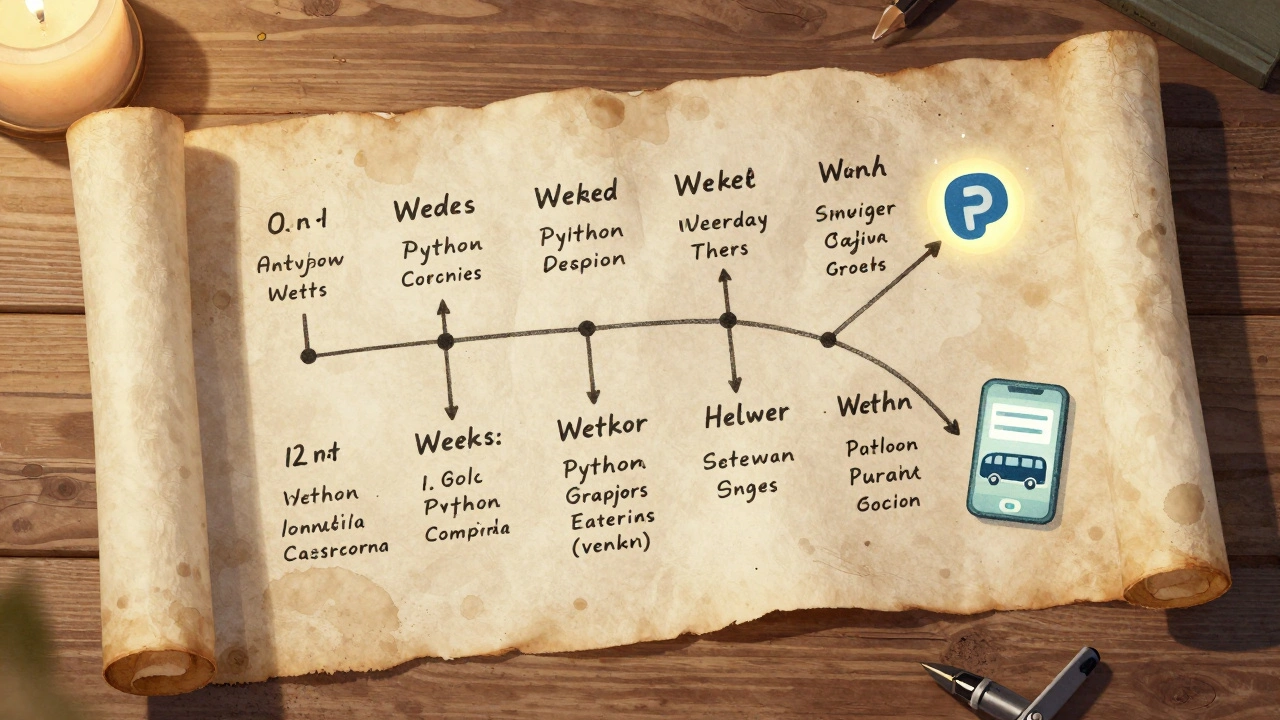
- Week 1-2: Learn basic syntax. Write programs that add numbers, ask for your name, and display it back.
- Week 3-4: Use loops and conditionals. Make a program that tells you if you’re old enough to vote or if a number is even or odd.
- Week 5-8: Work with lists and functions. Build a to-do list app that lets you add and delete items.
- Week 9-12: Connect to a simple API. Pull weather data or news headlines into your program.
By week 12, you’ll have built four small projects. That’s more than 90% of beginners manage. And that’s enough to feel confident.
Why coding classes work better than free tutorials
There are thousands of free coding videos on YouTube. So why do people pay for coding classes?
Because structure matters. Free tutorials are like a grocery store with 200 types of cereal-you can pick anything, but you don’t know what to buy first. Coding classes give you a shopping list. They tell you what to learn next, when to move on, and what to skip.
Good coding classes also give you feedback. You submit your code, someone reviews it, and tells you why it’s messy or inefficient. That’s something free videos can’t do. You won’t know you’re writing bad code unless someone points it out.
Classes also create accountability. If you’re paying money or signed up for a weekly session, you’re more likely to show up. Most people who learn coding alone quit within 30 days. Those in structured programs stick around.
What to avoid as a beginner
Here are the three biggest mistakes beginners make:
- Switching languages too often-You start with Python, then hear JavaScript is better, then try Java. You end up knowing nothing well.
- Trying to learn everything at once-Don’t try to learn HTML, CSS, JavaScript, databases, and frameworks in the first month. Focus on one thing until it clicks.
- Comparing yourself to experts-You’re not supposed to be as fast or as smart as someone who’s been coding for five years. You’re just starting. That’s okay.
Progress isn’t linear. Some days you’ll feel like a genius. Other days you’ll stare at your screen for an hour wondering why a single line won’t work. That’s normal. The key is to keep showing up.
Can you really get a job without a degree?
Yes. In 2025, over 40% of new software developers in the UK didn’t graduate with a computer science degree. Companies care more about what you can build than where you went to school.
Employers look for:
- Small projects you’ve built yourself
- GitHub profile with clean, commented code
- Ability to explain your thought process
- Willingness to learn and adapt
One person from Manchester got hired at a local tech startup after building a simple app that tracked local bus times. He didn’t have a degree. He didn’t know much about databases. But he solved a real problem. That’s what matters.
Final thought: It’s not about being good at coding-it’s about being stubborn
Coding isn’t hard because it’s complex. It’s hard because it’s frustrating. And most people quit before the frustration turns into mastery.
If you’re willing to sit with confusion for a few weeks, keep trying even when you feel stupid, and learn from your mistakes instead of giving up-you’ll get there. Not in a month. Not in two. But in three to six months, you’ll look back and realize you’ve changed. You’re not the same person who stared at a blank screen thinking, "I can’t do this."
You’re the person who did.