
NCLEX vs MCAT: Which Path Fits You?
Answer these questions honestly to see which exam aligns with your natural strengths and study style.
There is a persistent myth in the academic world that one standardized test reigns supreme in difficulty. Students often ask if the MCAT or the NCLEX is the bigger hurdle. The short answer? They are measuring entirely different skills, so comparing them directly is like asking whether lifting weights or running a marathon is harder. One tests your raw intellectual capacity and scientific reasoning; the other tests your clinical judgment and ability to keep patients alive under pressure.
To understand which one feels "harder" to you, we need to break down what each exam actually demands. If you are trying to decide between nursing school and medical school, or if you are just curious about the rigor of these pathways, this guide will strip away the hype and look at the facts.
What is the fundamental difference between the NCLEX and the MCAT?
The MCAT is a standardized entrance exam for medical schools that tests pre-clinical knowledge and critical analysis. It is taken before you start professional training. The NCLEX-RN is a licensure exam for registered nurses that tests entry-level clinical competency and patient safety. It is taken after you complete your nursing degree. One gets you into the classroom; the other lets you practice in the hospital.
The MCAT: A Test of Stamina and Science
The Medical College Admission Test (MCAT) is designed to filter candidates for medical school. It assumes you have completed undergraduate coursework in biology, chemistry, physics, and psychology. The exam does not care if you can perform a procedure; it cares if you can understand the underlying science and apply logical reasoning to complex problems.
The format is brutal by design. You sit for nearly eight hours straight. There are four sections:
- Bio/Biochem: Heavy on cellular processes and organic chemistry mechanisms.
- Chem/Phys: Physics principles applied to biological systems, plus general chemistry.
- Psych/Soc: Behavioral sciences, sociology, and research methods.
- CARS (Critical Analysis and Reasoning Skills): Reading comprehension passages from humanities and social sciences. This section has no specific content to study; it tests how fast and accurately you can process dense text.
The difficulty here lies in the volume of information. You must retain thousands of facts while simultaneously solving multi-step problems. A single question might require you to remember a chemical reaction, apply a physics formula, and interpret a graph all at once. The CARS section is particularly notorious because there is no right way to prepare for it other than reading extensively and practicing active analysis. Many students find the mental fatigue of sitting through four separate sections without a long break to be the hardest part.
If you struggle with abstract concepts, memorizing vast amounts of detail, or maintaining focus for seven-and-a-half hours, the MCAT will feel incredibly difficult. It is a gatekeeper exam. The average score for matriculants to U.S. medical schools hovers around 511-512 out of 528. Scoring high requires not just knowing the material, but mastering test-taking strategy.
The NCLEX: A Test of Judgment and Safety
The National Council Licensure Examination (NCLEX-RN) is the final boss of nursing school. Unlike the MCAT, which is static, the NCLEX uses Computerized Adaptive Testing (CAT). This means the computer selects your next question based on your answer to the previous one. If you get it right, the next question is harder. If you get it wrong, the next one is easier. The exam stops when the computer is 95% confident that you are either above or below the passing standard.
This creates a unique psychological pressure. You never know if you are doing well during the exam. You might answer ten questions correctly and feel great, only to face increasingly difficult scenarios that make you doubt yourself. Or you might struggle early on and wonder if you’ve already failed, even though the system is simply calibrating your baseline.
The content focuses on four major areas:
- Safe and Effective Care Environment: Prioritization, delegation, and legal/ethical issues.
- Health Promotion and Maintenance: Preventative care and growth/development.
- Psychosocial Integrity: Mental health and coping mechanisms.
- Physiological Integrity: Pharmacology, fluid/electrolyte balance, and reduction of risk potential.
The "hard" part of the NCLEX is not recalling facts-it’s applying them. Questions are rarely direct. Instead of asking "What is the dosage for Drug X?", they present a scenario: "A patient presents with symptoms A, B, and C. Which action should the nurse take first?" You have to prioritize. In nursing, prioritization is life or death. You must identify the most urgent threat to the patient’s airway, breathing, or circulation.
Many nursing students find this harder than their coursework because real-world nursing is messy. The NCLEX mimics that messiness. You need to think like a nurse, not just a student. You must anticipate complications and recognize subtle signs of deterioration. If you are good at memorization but weak at critical thinking under pressure, the NCLEX will trip you up.

Comparing the Difficulty: What Are You Up Against?
Let’s look at the tangible differences. The MCAT is a one-time event (usually) that determines your eligibility for education. The NCLEX is a career requirement. Failing the MCAT means you retake it later or apply elsewhere. Failing the NCLEX means you cannot work as a nurse, despite having a degree. That stakes-based anxiety adds a layer of difficulty to the NCLEX that the MCAT doesn’t quite replicate in the same way.
However, the academic ceiling of the MCAT is higher. The depth of biochemistry and physics required is significantly greater than what is tested on the NCLEX. If you are a STEM nerd who loves deep theoretical dives, the MCAT content might feel more intellectually stimulating, even if it’s exhausting. If you are a practical problem-solver who prefers concrete actions over abstract theories, the NCLEX will feel more natural, though still challenging due to its adaptive nature.
| Feature | MCAT | NCLEX-RN |
|---|---|---|
| Purpose | Medical School Admission | Nursing Licensure |
| Format | Fixed Sections (Multiple Choice) | Computerized Adaptive Testing (CAT) |
| Duration | ~7.5 hours | 2 to 6 hours (varies by performance) |
| Content Focus | Pre-clinical Sciences, Critical Reading | Clinical Judgment, Patient Safety |
| Pass Rate | N/A (Scored 495-528) | ~85-90% First Attempt |
| Primary Challenge | Volume of Knowledge & Endurance | Prioritization & Uncertainty |
It is worth noting that preparation strategies differ wildly. For the MCAT, you spend months reviewing textbooks and taking full-length practice exams. For the NCLEX, you spend weeks doing thousands of practice questions to train your brain to recognize patterns in clinical scenarios. The NCLEX prep is less about learning new things and more about refining your decision-making speed.
Some students argue that the NCLEX is harder because the margin for error is smaller in terms of patient outcomes. Others say the MCAT is harder because the competition is fiercer. Both views have merit. But objectively, the MCAT requires a broader and deeper base of scientific knowledge, while the NCLEX requires sharper immediate application skills.
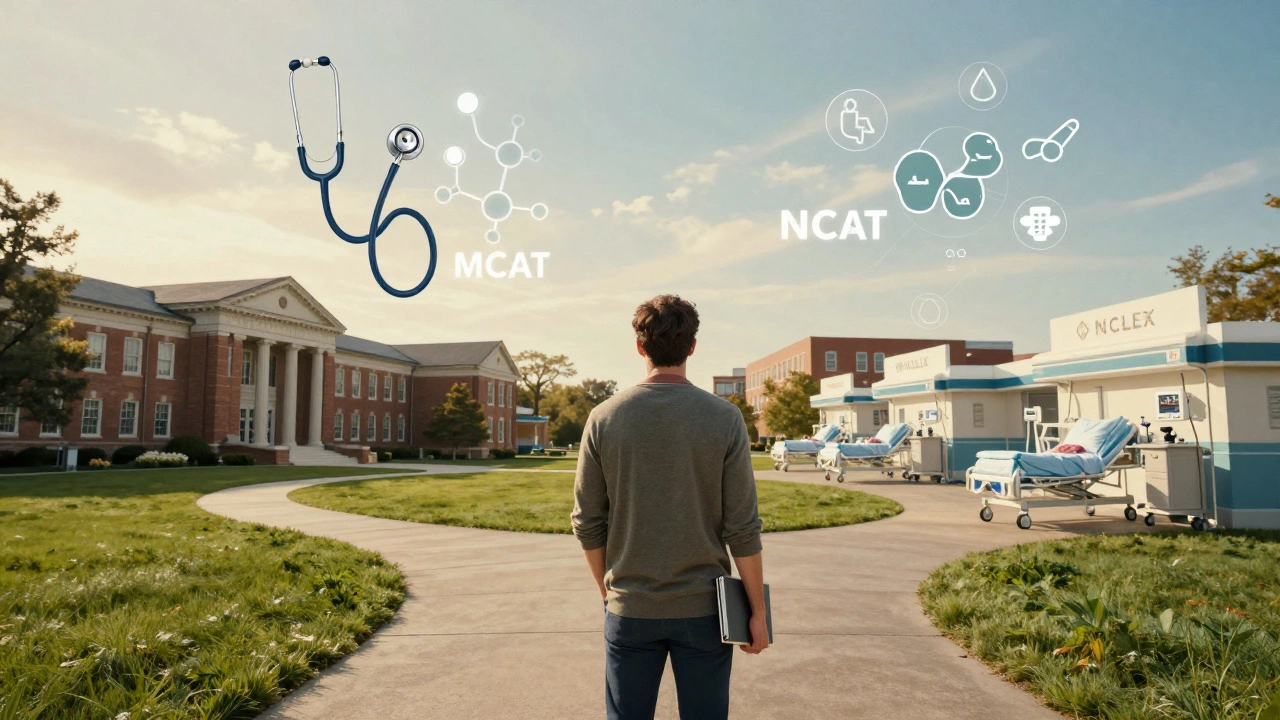
Which One Should You Prepare For?
Your choice depends on your career path. If you want to diagnose diseases, prescribe medication, and lead treatment teams, you aim for medical school, and thus the MCAT. If you want to provide hands-on patient care, educate families, and manage daily health needs, you aim for nursing, and thus the NCLEX.
Don’t let the fear of one exam steer you away from a profession you love. Both exams are passable with dedicated preparation. The key is understanding what kind of "hard" you are willing to endure. Do you prefer grinding through dense scientific texts for months (MCAT), or do you prefer honing your quick-thinking clinical instincts (NCLEX)?
Regardless of which path you choose, the journey is demanding. But both careers offer profound rewards. Nurses and doctors are the backbone of healthcare. Knowing which exam aligns with your strengths will help you tackle it with confidence rather than dread.
For those looking for resources to support their studies or needing a break from the intense preparation, sometimes stepping away helps. Whether it's finding a quiet study spot or exploring local directories for relaxation options like this resource, balancing stress is crucial for peak performance on test day.
Is the NCLEX harder than the MCAT for science majors?
Not necessarily. Science majors often excel at the MCAT due to their background in biology and chemistry. However, the NCLEX requires a different type of thinking-clinical judgment. A science major might find the NCLEX tricky if they try to over-analyze questions scientifically instead of focusing on patient safety protocols and prioritization.
Can I take the NCLEX if I have a bachelor's degree in a non-nursing field?
Yes, but you must first complete an accredited nursing program (BSN or ADN). The NCLEX is a licensure exam, not an entrance exam. You cannot take it until you have graduated from a nursing school.
How many times can you fail the MCAT?
You can take the MCAT up to seven times in your lifetime, and no more than three times in a single calendar year. However, multiple attempts may raise questions during medical school applications, so thorough preparation before retaking is advised.
Does the NCLEX change every year?
The core competencies remain consistent, but the National Council of State Boards of Nursing updates the test plan periodically to reflect changes in healthcare practices. Recent shifts emphasize clinical judgment models over rote memorization.
Which exam has a lower pass rate?
The NCLEX has a published pass rate (typically around 85-90% for first-time takers from U.S.-educated candidates). The MCAT does not have a "pass" rate; it produces a score. However, the effective barrier is high because top medical schools expect scores above 515. Statistically, more people fail the NCLEX outright than fail to achieve a competitive MCAT score, but the consequences differ.