Education Fit Finder: USA vs. India
Based on the article, different students thrive in different environments. Select the traits that best describe your preferences and goals to see which system is a better fit for you.
Which of these describe you? (Select all that apply)
Pro Tip for You:
Quick Takeaways
- India wins on theoretical depth and mathematical rigor.
- USA wins on critical thinking, flexibility, and extracurriculars.
- Indian students often struggle with soft skills; American students sometimes lack deep foundational knowledge in core sciences.
- The cost of education in the US is significantly higher, often leading to substantial student debt.
The Grind: Understanding the Indian Model
If you've ever looked at a CBSE syllabus, you know it's a marathon of content. The Central Board of Secondary Education is designed to create a standardized level of knowledge across a massive, diverse population. It's a system built for scale and competition. In India, education is often viewed as a filter. The goal isn't just to learn, but to outscore others to get into a limited number of elite seats.
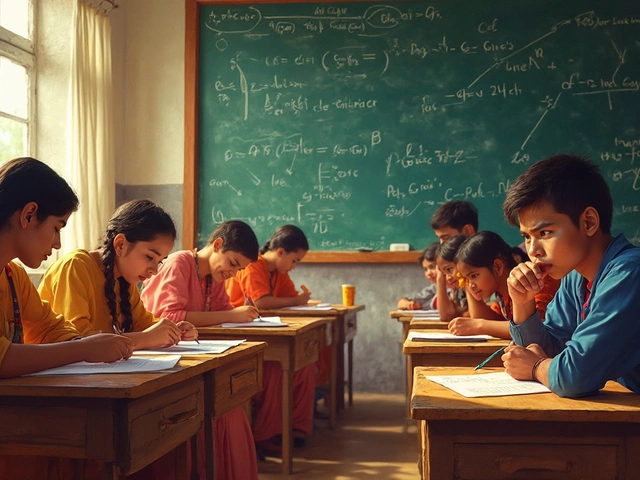
This creates a culture of extreme discipline. Indian students generally enter university with a much stronger grasp of calculus, physics, and chemistry than their American peers. This is why Indian engineers often dominate the technical ranks at global firms. However, this comes at a cost. The pressure to perform in the "board exams" often kills curiosity. When your entire future depends on a three-hour test, you stop asking "why" and start asking "will this be on the exam?"
The Exploration: How the US System Operates
The American approach is less about a national syllabus and more about a local experience. There is no single Department of Education mandate that tells every 10th grader exactly what page of a textbook to read. Instead, the US system emphasizes the "liberal arts" philosophy-the idea that a student should be well-rounded.
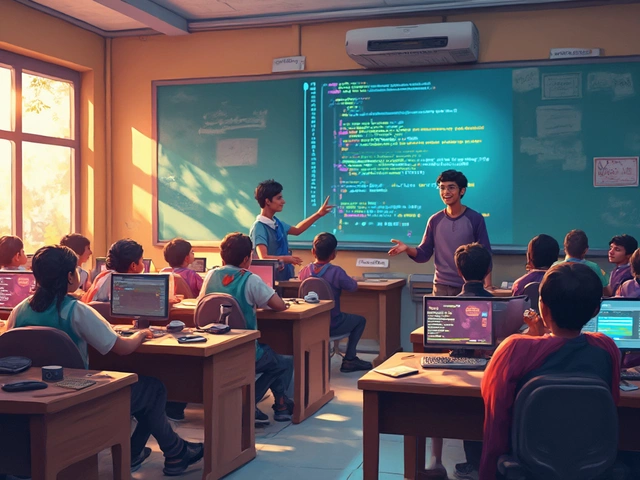
In a typical US high school, you'll find a mix of required credits and electives. A student might take Advanced Placement (AP) courses to challenge themselves, but they'll also take a class on psychology or digital media. The focus is on critical thinking and application. Instead of memorizing a historical date, an American student is more likely to be asked to write an essay analyzing the cause of a war. This fosters a level of confidence and public speaking ability that is often missing in the Indian classroom.
| Feature | Indian Education (CBSE/ICSE) | USA Education (K-12) |
|---|---|---|
| Primary Focus | Theoretical knowledge & Exams | Practical application & Holistic growth |
| Curriculum | Centralized and Rigid | Decentralized and Flexible |
| Assessment | High-stakes year-end exams | Continuous GPA & Portfolio building |
| Student Stress | High (Exam-driven) | Moderate to High (College Admissions) |
| Cost | Relatively Affordable | Very High (especially Higher Ed) |
The Higher Education Divide
The gap widens even more when we hit college. In India, the IITs (Indian Institutes of Technology) are the gold standard. Getting in is nearly impossible, but once you're there, the technical training is world-class. The focus remains on specialization from day one. You are an Electrical Engineer or a Mechanical Engineer, and that's your identity.
The US university system, including the Ivy League, encourages exploration. It's common for a student to enter as "undecided" and spend two years sampling different subjects before declaring a major. This allows for the intersection of ideas-like a computer science major who also studies philosophy. This intersection is where true innovation usually happens. However, the financial burden is the elephant in the room. While Indian degrees are largely accessible, US degrees can leave students with six-figure loans that take decades to pay off.
Which One Produces Better Professionals?
It depends on the job. If you need someone to solve a complex mathematical proof or execute a precise technical task without guidance, the Indian system's rigor is an asset. There is a reliability in the foundational knowledge that comes from the Indian school system.
On the other hand, if the role requires leadership, innovation, and the ability to pivot quickly in an ambiguous environment, the US system usually wins. American graduates are often better at networking and presenting their ideas. They are taught to question the status quo, whereas Indian students are often taught to respect the authority of the textbook. We are seeing a shift, though. New reforms in India are trying to move away from rote learning, and US schools are trying to bring back more rigor into their STEM programs.
The Practical Trade-offs for Students
Choosing between these systems-or deciding whether to move from one to the other-comes down to personality. Some students thrive under the pressure of a strict syllabus; they like knowing exactly what is expected of them. For them, the structure of a system like the CBSE provides a clear map to success.
Other students feel suffocated by that structure. They are the ones who want to build a robot in their garage or write a novel in high school. For these individuals, the American system is a playground of possibility. The risk in the US is that without a strong internal drive, a student can "glide' through high school with mediocre grades and a lack of deep knowledge in any one subject.
Common Pitfalls to Avoid
If you're moving from India to the US, the biggest shock isn't the language-it's the expectation of participation. In India, being a "good student" often means staying quiet and listening. In the US, a student who doesn't participate in class discussions can actually lose marks, even if their test scores are perfect. You have to learn to speak up.
Conversely, Indians moving into the US workforce often find that their technical skills are 10/10, but their "soft skills" are a 4/10. They can build the product, but they struggle to sell the vision. This is the missing piece that the American education system integrates from the age of five.
Is it harder to study in the US or India?
It's a different kind of hard. India is harder in terms of volume and memorization. You have to absorb vast amounts of data. The US is harder in terms of critical application and competition for prestige. In India, the struggle is with the syllabus; in the US, the struggle is often with the holistic requirements for top-tier college admissions.
Do US employers value Indian degrees?
Yes, especially in STEM fields. Degrees from top Indian institutions like the IITs or BITS are highly respected globally due to the known rigor of the entrance exams and the technical depth of the curriculum.
What is the biggest advantage of the CBSE syllabus?
The biggest advantage is consistency and depth. It ensures that students have a very strong grasp of core sciences and mathematics, which provides a competitive edge in technical fields and competitive exams.
Are American schools too easy?
Not necessarily, but they are more flexible. While the baseline might seem easier than the Indian system, the "ceiling" is very high. Students taking AP (Advanced Placement) or IB (International Baccalaureate) courses often cover university-level material while still in high school.
Which system is better for creativity?
The US system is generally better for creativity because it encourages risk-taking and permits failure. The Indian system, while improving, still heavily penalizes mistakes during exams, which can discourage students from experimenting.
What to do next?
If you are a student in India feeling burnt out by the rote learning, don't just jump ship. Start incorporating "American-style" learning on your own: read books outside your syllabus, join a debate club, or start a side project. You can get the best of both worlds by pairing Indian rigor with American curiosity.
For those planning to move to the US, focus on your portfolio. Your grades matter, but your stories-the things you did outside the classroom-will be the key to getting into a good program. Stop worrying only about the marks and start worrying about your impact.