There’s no single answer to "What is the hardest major?"-but if you’re preparing for competitive exams in India, you already know some paths are paved with more pressure, longer hours, and higher stakes than others. The hardest major isn’t just about the subject matter. It’s about the system around it: the number of applicants, the pass rates, the emotional toll, and how little room there is for error.
Engineering: IIT JEE Is the Gauntlet
If you’re aiming for an IIT, you’re joining a race where over 1.5 million students compete for about 18,000 seats. That’s a 1.2% selection rate. The JEE Advanced syllabus covers physics, chemistry, and math at a level most universities don’t teach until the second year of college. Students start preparing as early as Class 8. Many drop out of social life, skip holidays, and spend 12-14 hours a day solving problems. The pressure doesn’t come from the content alone-it comes from the fact that one wrong mark can cost you a top-tier college. A 2024 analysis of JEE Advanced results showed that 73% of qualified students scored within a 10-point range. That’s like running a marathon and losing your spot because you were 3 seconds slower than someone else.
Medicine: NEET’s All-or-Nothing Game
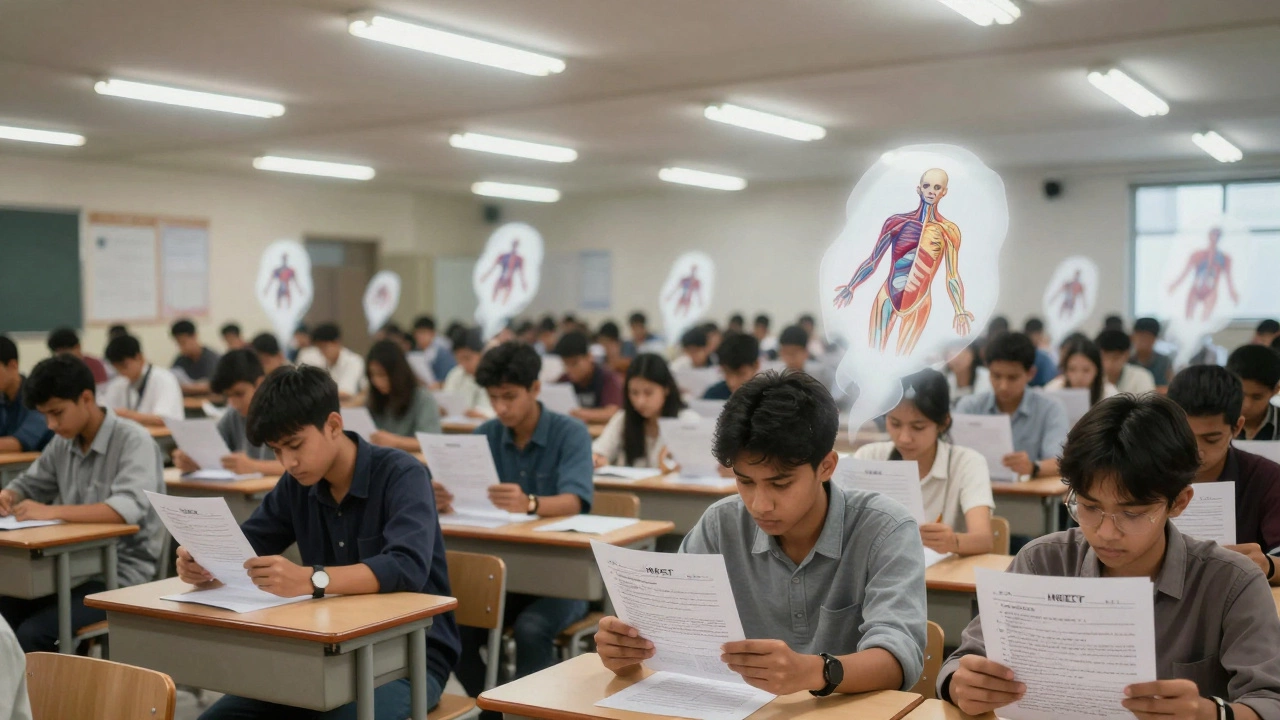
NEET is the gateway to 90% of medical seats in India. In 2025, over 2.3 million students took the exam for roughly 110,000 MBBS seats. That’s a 4.8% success rate. But here’s what makes it harder than engineering: you don’t just need to know biology. You need to memorize 1,200+ pages of human anatomy, physiology, and pharmacology. And you have to do it while balancing chemistry and physics. The exam doesn’t test understanding-it tests recall under extreme time pressure. One student from Varanasi told a local paper she spent 8 months memorizing the exact branching pattern of the brachial plexus. She got it right on the exam. She didn’t get into a government college. Her score was 12 points below the cutoff. That’s the reality: memorizing everything doesn’t guarantee anything.
UPSC Civil Services: The Marathon That Never Ends
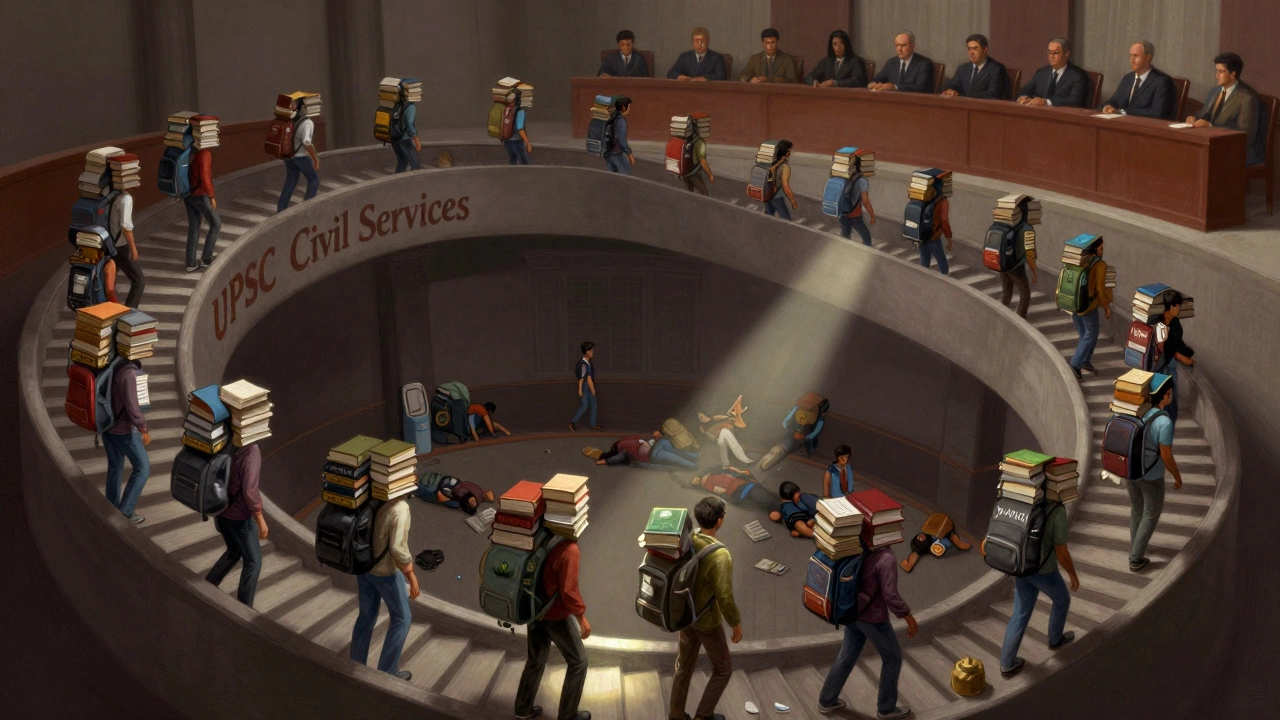
UPSC is different. It’s not a single exam-it’s a three-stage process that can take 2-3 years. The Prelims is a screening test with a 0.3% success rate. The Mains is 9 papers, each requiring 2,000-word answers on topics from international relations to ethics. Then there’s the interview, where your personality, opinions, and composure are judged by a panel of strangers. Unlike JEE or NEET, UPSC doesn’t have a fixed syllabus. You’re expected to know everything about India’s federal structure, global climate policy, and the history of tribal movements in Odisha. The average aspirant spends 8-10 hours a day for 2-3 years. Many fail multiple times. A 2023 survey found that 68% of successful candidates had attempted the exam at least twice. The hardest part? You’re competing against people who’ve been studying since they were 18, and you’re expected to sound like a policy expert by the time you’re 25.
Law: CLAT’s Hidden Complexity
CLAT is often called the "easy" alternative to engineering or medicine. It’s not. The exam tests logical reasoning, legal aptitude, English comprehension, and current affairs-all in 2 hours. But the real challenge isn’t the test. It’s the expectation. To get into NLU Delhi or NLSIU Bangalore, you need a score above 130 out of 150. That’s a 90% accuracy rate. And you’re expected to know landmark Supreme Court cases, constitutional amendments, and legal principles without ever having taken a law class. The syllabus changes every year. In 2024, 40% of the legal aptitude section came from cases decided in the last 6 months. Most students don’t realize how fast the law moves until they’re sitting in the exam hall.
Why "Hardest" Depends on Your Strengths
Some people find math intuitive. Others can memorize biology like poetry. The hardest major isn’t the same for everyone. A student who can solve calculus problems in their head might find NEET unbearable. Someone who can write 10,000-word essays might crush UPSC but freeze at JEE’s numerical problems. The real question isn’t which major is hardest-it’s which one matches your brain. A 2024 study by the National Council for Educational Research and Training found that students who chose their exam path based on interest, not parental pressure, were 3.2 times more likely to clear it on the first attempt. The system pushes you to pick the "toughest" path because it sounds impressive. But toughness without alignment leads to burnout.
What No One Tells You About the Hardest Majors
There’s a myth that if you work hard enough, you’ll win. That’s not true. Hard work is table stakes. What separates those who succeed is strategy, mental resilience, and knowing when to rest. Top performers don’t study more-they study smarter. They track their weak areas with precision. They take timed mock tests every week. They sleep 7 hours. They talk to mentors who’ve been through it. They know that 10% of their mistakes come from careless errors, not lack of knowledge. And they accept that failure is part of the process. One IIT topper from Kota admitted he failed JEE twice. He said his third attempt worked because he stopped comparing himself to others and focused only on his own progress.
Is There a "Best" Hardest Major?
No. But if you’re asking because you’re trying to decide where to invest your time, here’s what matters: your energy, your support system, and your long-term vision. Engineering gives you global mobility. Medicine gives you purpose. UPSC gives you influence. Law gives you voice. None of them are easy. But if you’re choosing based on prestige, you’ll burn out. If you’re choosing because you can’t imagine doing anything else, you might just make it.