
IIT Admission Rank Predictor (2026)
Enter Your Details
Results will appear here
You’ve cracked JEE Advanced is the gateway examination for admission to the Indian Institutes of Technology (IITs).. The relief you feel is real. But then comes the next question, the one that keeps every aspirant up at night: "What rank do I actually need?" It’s not a single number. It depends on your category, your gender, and which specific branch of engineering you want to study.
If you are aiming for Computer Science at IIT Bombay, the bar is sky-high. If you are looking at Chemical Engineering at an older IIT or any branch at a newer one, the requirements shift dramatically. Let’s break down exactly what ranks get you into which colleges in the 2026 cycle, based on recent trends and seat matrix data.
The Quick Answer: General Category Benchmarks
For a general category candidate (GEN/EWS), here is the rough reality check for 2026 admissions:
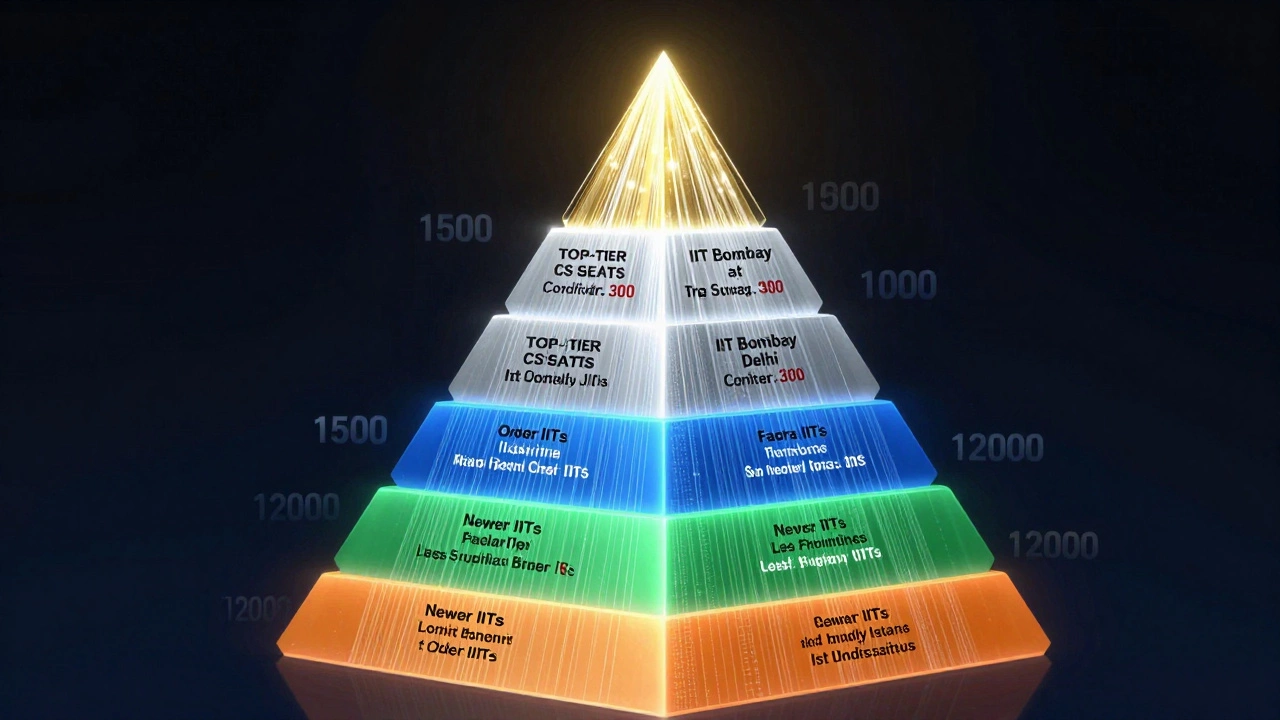
- Top Tier (CS/AI/DS at IIT Bombay/Delhi/Madras): You typically need a rank under 100-300. These seats are fiercely contested.
- Core Branches (Mechanical/Civil/Electrical) at Top 5 IITs: A rank between 400 and 1,500 usually secures you a spot.
- Any Branch at Old IITs (Kharagpur, Kanpur, Chennai, etc.): Ranks between 1,500 and 3,500 give you good options.
- Newer IITs (Indore, Patna, Bhubaneswar, etc.): Ranks from 3,500 to 8,000 can still land you in a reputable IIT with decent branches.
- Last Call for Any IIT Seat: Historically, the cutoff for the last seat in any IIT for General category hovers around 10,000 to 12,000. However, this is risky and often limited to less popular branches like Humanities or niche engineering fields.
| Institute & Branch Preference | Required Rank Range | Difficulty Level |
|---|---|---|
| IIT Bombay / Delhi - CS/AI | < 300 | Extreme |
| Top 5 IITs - Core Engineering | 400 - 1,500 | High |
| Old IITs - Any Branch | 1,500 - 3,500 | Moderate-High |
| Newer IITs - Popular Branches | 3,500 - 7,000 | Moderate |
| Any IIT - Least Preferred Branch | 7,000 - 11,000 | Low-Moderate |
How Categories Change the Game
The reservation policy in India significantly alters the rank requirements. If you belong to OBC-NCL, SC, or ST categories, your chances of getting into top institutes improve substantially relative to your rank.
For OBC-NCL candidates, the cutoff for top branches usually extends up to 800-1,200 for IIT Bombay/Delhi CS. For general entry into any IIT, ranks up to 15,000-18,000 have historically seen admissions.
SC Candidates can secure top branches with ranks between 2,000 and 4,000. Getting into *any* IIT is possible with ranks extending beyond 30,000-40,000, depending on the year's difficulty and seat availability.
ST Candidates have the most relaxed cutoffs. Top branches might require a rank under 5,000-7,000, while securing a seat in any IIT is often feasible with ranks up to 50,000+.
Remember, these numbers fluctuate. A tough exam paper raises everyone's scores, but it also tightens the competition because fewer people qualify. An easy paper does the opposite. Always look at the trend over the last three years, not just one.
Gender Quotas: The Female Candidate Advantage
If you are a female candidate, you have a distinct advantage due to the Supernumerary Seats reserved specifically for women. Each IIT reserves 25% of its seats for female students. This means a female candidate with a rank of 5,000 has a much better chance of getting into IIT Bombay than a male candidate with the same rank.
Female candidates often see cutoffs extended by 2x to 3x compared to their male counterparts in the same category. For instance, a female General category student might secure a Computer Science seat at an old IIT with a rank around 1,500-2,000, whereas a male student would need to be in the top 300.
Branch vs. College: What Should You Prioritize?
This is where most students make a mistake during JoSAA Counseling is the joint seat allocation authority process that assigns seats to JEE Advanced qualifiers.. They obsess over the college name and ignore the branch. Or vice versa.
Here is the truth: In the first two years, all engineering students at an IIT take the same core courses. Physics, Chemistry, Math, and basic programming are identical whether you are Mechanical or Civil. Your specialization starts in the third year.
If you get a rank of 2,500, you face a choice:
- Option A: Take a lower-preference branch (like Metallurgy or Mining) at IIT Bombay.
- Option B: Take a top-tier branch (like Computer Science or Electrical) at IIT Kharagpur or IIT Madras.
Most industry recruiters care more about your skills and internships than your specific undergraduate major. Many IITians switch branches later via lateral entry or pursue MS abroad in different fields. Therefore, if you love coding, choosing CS at a slightly lower-ranked IIT might offer better peer group synergy and club opportunities than struggling in a branch you dislike at the top institute.
Understanding the JoSAA Round System
Your rank isn't just used once. JoSAA runs multiple rounds. This is crucial for strategy.
Round 1: Most seats are filled here. If you freeze your choice, you’re done. If you float, you can upgrade in Round 2. If you slide, you might get a worse option if no upgrades happen.
Round 2 & 3: These rounds pick up the leftover seats. Many students vacate seats to go to NITs or IIITs if they didn't get their dream IIT branch. This is your golden window. A rank of 8,000 might not get you anything in Round 1, but in Round 3, you could snag a Mechanical seat at IIT Guwahati because someone else upgraded to CS.
Strategic Tip: Never fill only 10 choices. Fill the maximum allowed (usually 100+). Put your moonshots first, your realistic targets in the middle, and your safety nets at the bottom. The algorithm works in order. If you don't list a college, you can't get it, even if your rank qualifies.

Common Pitfalls to Avoid
Even with a great rank, you can lose your seat if you mess up the logistics.
- Ignoring Medical Fitness: Some branches have medical restrictions. Color blindness can rule out certain design or chemistry-heavy roles. Check the brochure.
- Missing Deadlines: JoSAA deadlines are strict. No extensions. Mark them on your calendar now.
- Paying the Fee Late: Once allocated, you have a short window to pay the admission fee. Failure to do so results in de-selection. You will have to wait for the next round, losing time and hope.
- Fake News: Ignore WhatsApp forwards about "management quotas" or "pay-and-join" schemes in IITs. They do not exist. IIT admissions are 100% merit-based through JEE Advanced.
What If My Rank Is Below 12,000?
Don’t panic. If you are a General category student with a rank below 12,000, you might miss out on IITs. However, you are in a prime position for National Institutes of Technology (NITs) are public technical universities in India that offer high-quality engineering education.. Top NITs like Trichy, Warangal, and Surathkal have excellent placement records, sometimes rivaling mid-tier IITs.
A rank of 15,000-25,000 in JEE Main (which determines NIT admissions) can get you Computer Science at a top NIT. This is often a smarter career move than taking a obscure branch at a lower-tier private college.
Is a rank of 10,000 enough for any IIT?
For General category students, a rank of 10,000 is borderline. You might get a seat in a newer IIT or a less popular branch in an older IIT, but it is not guaranteed. For OBC/SC/ST categories, yes, 10,000 is a very safe rank for securing a seat in almost any IIT.
Does JEE Advanced rank reset every year?
Yes. Your rank is valid only for the current academic year. You cannot carry forward a rank from 2025 to 2026. You must appear for the exam again and qualify anew.
Which is better: IIT Gandhinagar CS or IIT Bombay Metallurgy?
This depends on your career goals. If you want to work in software immediately after graduation, IIT Gandhinagar CS offers better curriculum alignment and peer networking. If you plan to do an MBA or MS abroad later, the brand value of IIT Bombay might help, but the branch mismatch could be a hurdle in interviews. Most experts recommend prioritizing the branch you enjoy studying for four years.
Can I change my branch after joining IIT?
Direct branch changes are extremely rare and difficult. However, many IITs allow "lateral entry" into other departments after the second year if you maintain a high CGPA. Additionally, you can pursue minors, dual degrees, or postgraduate studies in different fields.
What happens if I don't get my desired seat in Round 1?
You can choose to "float" your seat, meaning you remain eligible for upgrades in subsequent rounds. If you "freeze," you keep the seat but exit the process. If you "slide," you accept the seat but can be moved to a lower preference if higher ones open up. Floating is generally recommended if you are close to your target rank.