
JEE Self-Study Success Calculator
Your Potential
Your Personalized Strategy Guide
Here is the raw truth that most tuition centers won’t tell you: IIT JEE is India's premier engineering entrance examination, known for its extreme difficulty and low selection rate of less than 1%. The myth that you need a ₹5 lakh coaching package to clear it is just that-a myth. Every year, thousands of students secure top ranks in both JEE Main and JEE Advanced through pure self-study. But here is the catch: doing it alone requires more discipline, better resources, and a smarter strategy than sitting in a classroom ever did.
If you are asking yourself whether you can crack IIT JEE without coaching, the answer is yes. However, "yes" doesn't mean "easy." It means you have to replace the structure of a classroom with the structure of your own life. This guide breaks down exactly how to build that structure, what resources to use, and where most self-learners fail so you don't make the same mistakes.
The Reality Check: Why Students Choose Self-Study
Before we get into the tactics, let's look at why this path is gaining traction. In 2024 and 2025, the landscape of competitive exams shifted. With the rise of high-quality digital content, the monopoly traditional coaching institutes held on information has broken.
Students choose self-study for three main reasons:
- Cost Efficiency: Quality coaching can cost anywhere from ₹2 lakhs to ₹6 lakhs. Self-study costs a fraction of that-mostly for books and online test series.
- Pace Control: In a classroom, the teacher moves at an average speed. If you understand a concept quickly, you wait. If you struggle, you fall behind. Self-study lets you spend 10 hours on Thermodynamics if needed, or 30 minutes on Vector Algebra if it clicks instantly.
- Personalized Learning: You know your weak spots. You don't need to review chapters you already mastered just because the batch is there.
However, this freedom comes with a heavy price tag: accountability. No one is coming to check your homework. No one is forcing you to take a mock test. If you lack self-discipline, self-study will fail you faster than any bad teacher could.
The Core Strategy: Building Your Study Architecture
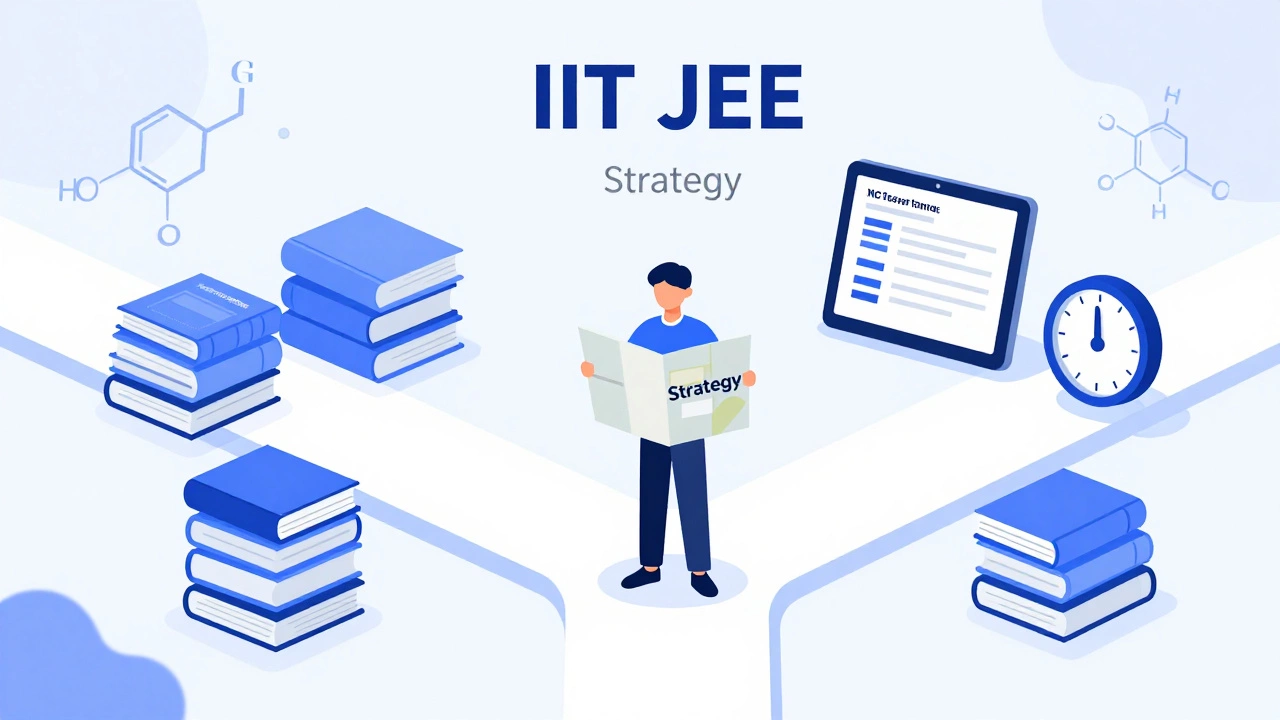
To succeed without coaching, you cannot just "study hard." You must study systematically. Think of yourself as the project manager of your education. Here is the framework that successful self-taught candidates follow.
1. Master the Basics with NCERT
Many students skip NCERT textbooks are the standard curriculum books prescribed by the National Council of Educational Research and Training for Indian schools. They think they are too simple. This is a fatal error. For JEE Main, especially in Chemistry and Physics, NCERT is the bible. For Biology (if you are taking JEE Main Paper 1 with Bio) and Chemistry theory, lines from NCERT often appear verbatim in questions. Read every line. Solve every example. Treat it like a novel, not a reference book.
2. Select the Right Reference Books
You don't need ten books. You need two or three masterpieces. Quality over quantity is the rule here. Here is a curated list that replaces the bulk of coaching modules:
| Subject | Concept Building | Problem Solving |
|---|---|---|
| Physics | HC Verma (Concepts of Physics) | Irodov (Problems in General Physics) - Optional for Advanced |
| Chemistry | NCERT + OP Tandon (Physical/Organic) | M.S. Chouhan (Organic), N Awasthi (Physical) |
| Mathematics | RD Sharma (for basics) + SL Loney (Trigonometry) | Arihant Series (Chapter-wise) + Cengage |
Note: Do not buy all these at once. Start with one per subject. Finish it. Then move to the next. Hoarding books creates anxiety, not knowledge.
3. Digital Resources as Your Teachers
Since you don't have a teacher, you need substitutes. Free and paid platforms have revolutionized access to quality instruction.
- Khan Academy: Excellent for building foundational concepts in Physics and Math. Use it when you are stuck on a basic idea.
- Unacademy / Vedantu / Physics Wallah: These platforms offer free live classes and recorded lectures. Pick one teacher whose style resonates with you and stick to them. Don't jump between five different teachers for the same chapter.
- YouTube Channels: Channels like Eduniti, Pradeep Kshetrapal, and Ranveer Shukla provide deep conceptual clarity. Use them for specific doubts, not as a primary syllabus driver.
The Non-Negotiable: Mock Tests and Analysis
This is where 90% of self-studying students fail. They read books, solve problems, and feel confident. Then they sit for a mock test and score poorly. Why? Because solving a problem and solving a problem under time pressure are two different skills.
You must enroll in a reliable test series. Options like Allen, Resonance, or even online-only providers like Embibe or Gradeup offer affordable packages. Here is the rule:
- Frequency: Take at least one full-length mock test every week during the first six months. Increase to two or three per week in the final four months.
- Simulation: Sit in a quiet room. No phone. No breaks. Follow the exact exam timing (e.g., 9 AM to 12 PM). Train your brain to perform at peak capacity during those hours.
- Analysis is Key: Spending 3 hours on a test is useless if you don't spend 3 hours analyzing it. Categorize every mistake:
- Silly Error: Calculation mistake, misreading the question.
- Conceptual Gap: Didn't know the formula or principle.
- Time Management: Spent too long on a hard question and ran out of time for easy ones.
Your analysis report becomes your study plan for the next week. If you failed in Electrostatics, your next three days are dedicated solely to Electrostatics. This feedback loop is what replaces the teacher's correction.
Creating a Sustainable Routine
Consistency beats intensity. Studying 18 hours for one day and then sleeping for two days is counterproductive. Aim for a steady 8-10 hours of focused study daily.
Here is a sample schedule that works for many self-learners:
- 6:00 AM - 8:00 AM: Revision of previous day's topics (Active Recall).
- 8:30 AM - 12:30 PM: New Concept Learning (Watch lecture + Read theory).
- 1:30 PM - 4:30 PM: Problem Solving (Apply what you learned).
- 5:30 PM - 7:30 PM: Weak Area Focus (Tackle subjects you find difficult).
- 8:00 PM - 9:00 PM: Light Reading / Formula Sheet Review.
Include one day off per week. Burnout is real. If you are exhausted, your brain stops retaining information. Sleep 7-8 hours. Exercise for 30 minutes. These are not distractions; they are performance enhancers.
Common Pitfalls to Avoid
Self-study is a minefield of distractions. Watch out for these traps:
- Resource Overload: Downloading 50 PDFs and watching 100 videos without solving a single problem. Action > Consumption.
- Isolation: Cutting off all social contact can lead to depression. Maintain a small group of serious friends who are also preparing. Discuss doubts with them. Teaching a concept to a friend is the best way to learn it.
- Ignoring JEE Main: Many students focus only on JEE Advanced because it's harder. Remember, JEE Main is the gateway. A good rank in Main can get you into top NITs and IIITs, which are excellent alternatives. Don't put all your eggs in one basket.
- Perfectionism: Trying to solve every single problem in a book. Some problems are designed to be impossible. Learn to identify patterns and skip the outliers.
When Should You Consider Coaching?
Be honest with yourself. Self-study might not be for you if:
- You consistently procrastinate despite having a plan.
- You cannot explain basic concepts to yourself after reading them.
- You lack access to a quiet study environment.
- You thrive on external motivation and peer competition.
In these cases, a hybrid model might work. Join a weekend batch or an online doubt-clearing service while keeping your primary study self-driven. The goal is to remove the barriers to your learning, not to add more stress.
Final Thoughts: Mindset is Everything
Cracking IIT JEE without coaching is a testament to your resilience. It proves that you can manage time, resources, and emotions independently. This skill is far more valuable in engineering college-and in life-than knowing how to integrate a complex function.
Start today. Not tomorrow. Pick up your NCERT Physics book. Read the first chapter. Solve the exercises. That is the only step that matters. The rest will follow.
Is it possible to get an AIR under 1000 in JEE Advanced without coaching?
Yes, it is absolutely possible. While coaching provides structure, many top rankers are self-taught. The key is rigorous practice, consistent mock tests, and mastering fundamentals. Look at past years' data; a significant percentage of top 1000 ranks come from non-coaching backgrounds or rural areas with limited resources.
Which online platform is best for JEE self-study?
There is no single "best" platform. Khan Academy is great for basics. Unacademy and Physics Wallah offer comprehensive courses. The best choice depends on your learning style. Try free demos of multiple platforms before committing. Consistency with one resource is better than jumping between several.
How many hours should I study daily for JEE without coaching?
Quality matters more than quantity. Aim for 8-10 hours of focused, distraction-free study. If you study 14 hours but are distracted half the time, it’s worse than 6 hours of intense focus. Break your day into blocks with short breaks to maintain mental freshness.
Should I join a test series if I am self-studying?
Yes, it is highly recommended. Test series provide exposure to the exam pattern, help in time management, and give you a realistic assessment of your preparation level. Analyzing these tests is crucial for identifying weak areas and improving your strategy.
What are the biggest challenges of self-studying for JEE?
The biggest challenges are lack of accountability, difficulty in clearing doubts quickly, and potential isolation. To overcome these, create a strict schedule, use online forums or apps for doubt resolution, and connect with a small group of serious peers for motivation and discussion.