
MBA Return on Investment (ROI) Calculator
There is a persistent myth that getting an MBA is a Master of Business Administration degree that guarantees immediate financial windfall and executive status automatically leads to a massive pay raise. If you are sitting there wondering whether the tuition fees and opportunity costs are worth it, you are not alone. The short answer is yes, but with significant caveats. An MBA does not act as a magic wand; it acts as a lever. It amplifies your existing value, network, and strategic positioning.
In 2026, the landscape of business education has shifted. With AI handling routine analytical tasks, the premium on human-led strategy, leadership, and complex problem-solving has actually increased. However, the return on investment (ROI) varies wildly depending on where you study, what industry you target, and how you leverage the credential during your job search. Let’s break down the real numbers, the hidden costs, and the specific scenarios where an MBA pays off-and where it might just be a expensive hobby.
The Real Numbers: Pre-MBA vs. Post-MBA Earnings
To understand if an MBA increases salary, we have to look at the median data rather than the outliers. The top-tier programs often publish their own statistics, which can skew perception. According to recent data from major business school rankings like Financial Times and Poets&Quants, graduates from top-ranked schools see a significant jump in compensation.
For instance, graduates from elite institutions like Harvard Business School or Stanford Graduate School of Business often report median base salaries exceeding $185,000, with total compensation packages (including bonuses and equity) reaching over $230,000. In contrast, the median pre-MBA salary for these same students was typically around $90,000 to $110,000. This represents a near-doubling of income within two years of graduation.
However, this trend flattens out significantly for mid-tier and lower-ranked programs. For a generic online MBA or a program from a less recognized university, the salary bump might only be 10% to 15%. In some cases, if you do not change jobs after graduation, your salary may stagnate entirely. The key insight here is that the degree itself does not raise your salary; the job change enabled by the degree does.
| Program Tier | Pre-MBA Median Salary | Post-MBA Median Base Salary | Total Compensation (Base + Bonus) | Avg. Tuition Cost |
|---|---|---|---|---|
| Top-Tier (M7, etc.) | $105,000 | $185,000 | $240,000+ | $180,000 - $220,000 |
| Mid-Tier Regional | $75,000 | $95,000 | $110,000 | $60,000 - $90,000 |
| Online/Part-Time | $70,000 | $80,000 | $90,000 | $20,000 - $40,000 |
The Hidden Costs: Opportunity Cost and Debt
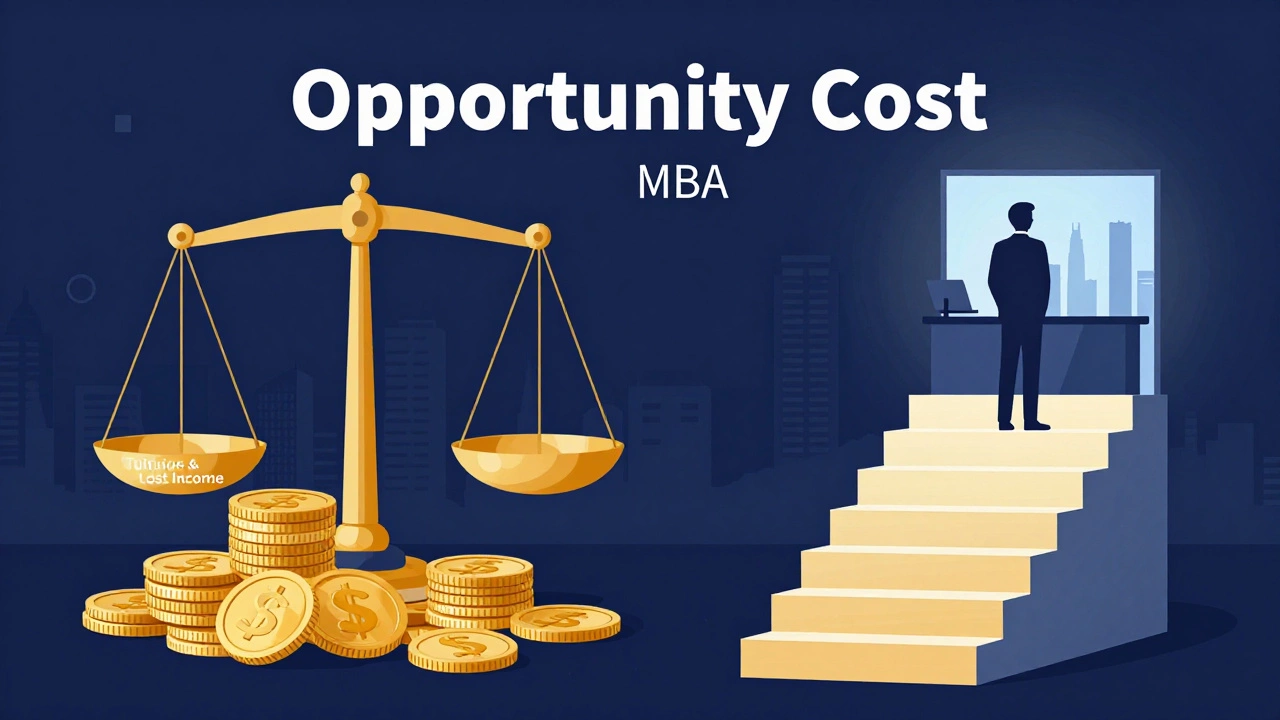
When calculating whether an MBA increases your net worth, you must account for more than just tuition. The biggest expense is often the Opportunity Cost. This is the income you forego by leaving your current job to study full-time for two years.
If you earn $100,000 a year and take two years off, you lose $200,000 in salary, plus benefits, retirement contributions, and career progression. Add tuition fees of $150,000, living expenses of $50,000 per year, and books/materials, and the total cost of attendance easily exceeds $400,000. To break even, your post-MBA salary needs to be substantially higher than your pre-MBA salary, and you need to maintain that higher income for several years.
This is why debt-to-income ratio matters. Graduates who finance their MBA with loans face a "debt trap" if they land a role that doesn’t offer a high enough starting salary. Conversely, those who self-fund or receive scholarships see a much faster ROI. Always calculate your personal break-even point before enrolling.
Industry Switching: The Primary Driver of Salary Growth
The most common reason people get an MBA is not just to get a raise in their current role, but to pivot into a higher-paying industry. This is where the degree shines brightest. Consider these typical transitions:
- Engineering to Consulting: Engineers often hit a salary ceiling in technical roles. An MBA allows them to move into management consulting firms like McKinsey or BCG, where entry-level consultants can earn $170,000+ in total compensation.
- Non-Profit to Corporate: Professionals in non-profits often work for passion, not pay. An MBA provides the credibility and network to transition into corporate social responsibility (CSR) or general management roles in the private sector, doubling their income.
- Marketing to Product Management: As tech companies dominate hiring, product managers command higher salaries than traditional marketers. An MBA with a tech focus facilitates this switch.
Without the MBA, these switches are difficult because employers view candidates as lacking relevant experience. The degree acts as a signal of competence and a bridge across industries.
The Network Effect: Who You Know Matters More Than What You Know
In 2026, the curriculum of an MBA is increasingly accessible via online courses and certifications. You can learn finance, marketing, and operations from platforms like Coursera or edX for a fraction of the cost. So, what are you really paying for? You are paying for access to the Alumni Network.
High-salary jobs are rarely advertised publicly. They are filled through referrals and internal networks. A strong alumni network opens doors to hidden job markets. For example, a graduate from a top-tier school might receive an interview invitation simply because a recruiter is also an alum. This network effect compounds over time. Ten years post-graduation, the salary difference between MBA holders and non-holders widens significantly due to promotions into C-suite roles, which are heavily influenced by networking.
Online vs. On-Campus: Does Format Matter for Salary?
The rise of Online MBA Programs has democratized access to business education. But does an online MBA yield the same salary boost? Generally, no. Employers still distinguish between on-campus and online degrees, particularly for competitive roles in investment banking, private equity, and top-tier consulting.
On-campus programs offer immersive experiences, peer learning, and direct access to campus recruiters. Online programs are better suited for professionals who want to upskill while maintaining their current job trajectory. If you stay in your current company after completing an online MBA, you might get a promotion and a modest raise. If you leave to seek a new role, you will compete against on-campus graduates who have stronger brand recognition.
That said, reputable online MBAs from established universities (like Indiana Kelley or UT Austin McCombs) are gaining respect. The gap is narrowing, but for maximum salary impact, the on-campus experience remains superior.

When an MBA Does NOT Increase Salary
It is crucial to acknowledge scenarios where an MBA fails to deliver financial returns. Here are the red flags:
- Staying in the Same Role: If you get an MBA but remain in the same position at the same company without a title change, your salary will likely not increase significantly. Companies do not automatically reward degrees unless tied to a promotion.
- Low-Ranked Programs: Degrees from unaccredited or poorly ranked schools carry little weight. Recruiters filter by school reputation first. If your school is not on their list, your resume may never reach a human reader.
- Over-Leveraged Debt: If you graduate with $200,000 in debt and land a job paying $80,000, your net financial position worsens. The monthly loan payments eat into your disposable income, negating any perceived "raise."
- Saturated Industries: Some sectors, like retail management or administrative support, have limited salary ceilings. An MBA may not help you break through these structural limits.
Strategic Steps to Maximize Your MBA ROI
If you decide to pursue an MBA, treat it as a business venture. Your goal is to maximize return. Here is how to ensure your salary increases:
- Choose the Right School: Prioritize schools with strong career services and recruiting partnerships in your target industry. Research employment reports thoroughly.
- Internship Performance: Your summer internship is critical. Many full-time offers come from internship conversions. Treat the internship as a three-month interview.
- Leverage Career Services: Use the school’s career center for resume reviews, mock interviews, and salary negotiation coaching. Do not negotiate alone.
- Build Your Personal Brand: Engage with alumni on LinkedIn. Attend networking events. Build relationships before you need them.
- Target High-Growth Sectors: Focus on industries like technology, healthcare, and renewable energy, where demand for skilled managers is high and salaries are rising.
How long does it take to recoup the cost of an MBA?
The payback period varies by program tier. For top-tier MBAs, graduates often recoup their investment within 3 to 5 years due to high starting salaries. For mid-tier programs, it may take 5 to 7 years. Online MBAs, being cheaper, might have a shorter payback period if they lead to a promotion, but the absolute salary gain is lower.
Is an MBA worth it if I already have a Master's degree?
Yes, if your previous Master's is in a specialized field like Engineering or Science. An MBA adds business acumen, leadership skills, and a broader network, making you eligible for general management roles that pure technical degrees do not provide. However, if you already have a business-focused Master's, an MBA may offer diminishing returns.
Do employers care about the ranking of my MBA school?
Absolutely. Top consulting firms, investment banks, and tech companies use school rankings as a primary screening tool. Graduates from top-20 schools have a distinct advantage in accessing these high-paying roles. For other industries, the ranking matters less, but the network strength still correlates with school prestige.
Can I get an MBA salary boost without going full-time?
It is possible but harder. Part-time and Executive MBAs allow you to keep working, so you avoid opportunity cost. However, you miss out on the structured recruitment process and internships. To see a salary boost, you must proactively network and leverage your current employer for promotions based on your new qualifications.
What is the average salary increase for MBA graduates in 2026?
On average, MBA graduates see a 30% to 50% increase in base salary compared to their pre-MBA earnings. For top-tier programs, this increase can exceed 100%. However, this average masks significant variation based on industry, location, and individual performance.