
Federal Job Eligibility Checker
Check Your Background Eligibility
Identify potential roadblocks before applying
Eligibility Assessment
Results will appear here after checking
Getting a federal job sounds like a solid plan-steady pay, good benefits, job security. But thousands of people apply every year and never hear back. Why? It’s not always about qualifications. Sometimes, it’s the hidden roadblocks you didn’t even know existed. If you’ve been stuck in the application process, it’s probably not because you’re not good enough. It’s because something in your background, your paperwork, or your approach is blocking you. Let’s cut through the noise and look at the real reasons people get turned down.
Your background check isn’t just a formality
The federal government runs deeper background checks than any private employer. It’s not just about criminal records. They look at your financial history, foreign contacts, drug use, even your social media activity from the last seven years. A single unpaid credit card from 2020? That’s not a deal-breaker by itself. But if you’ve got $15,000 in overdue debt, multiple collections, or a history of missed payments, it raises a red flag. Why? Because federal jobs often involve access to sensitive data or funds. They don’t want someone who might be vulnerable to bribery or coercion.
Drug use is another silent killer. Even if it happened years ago, if you used marijuana, cocaine, or other illegal substances within the last year, you’re likely disqualified. Some agencies allow for exceptions if you can prove you’ve been clean for three years and have completed rehabilitation. But that’s rare. And yes-they test for it. Not just during hiring. Random drug screenings happen throughout your career.
Missing or incomplete paperwork kills applications
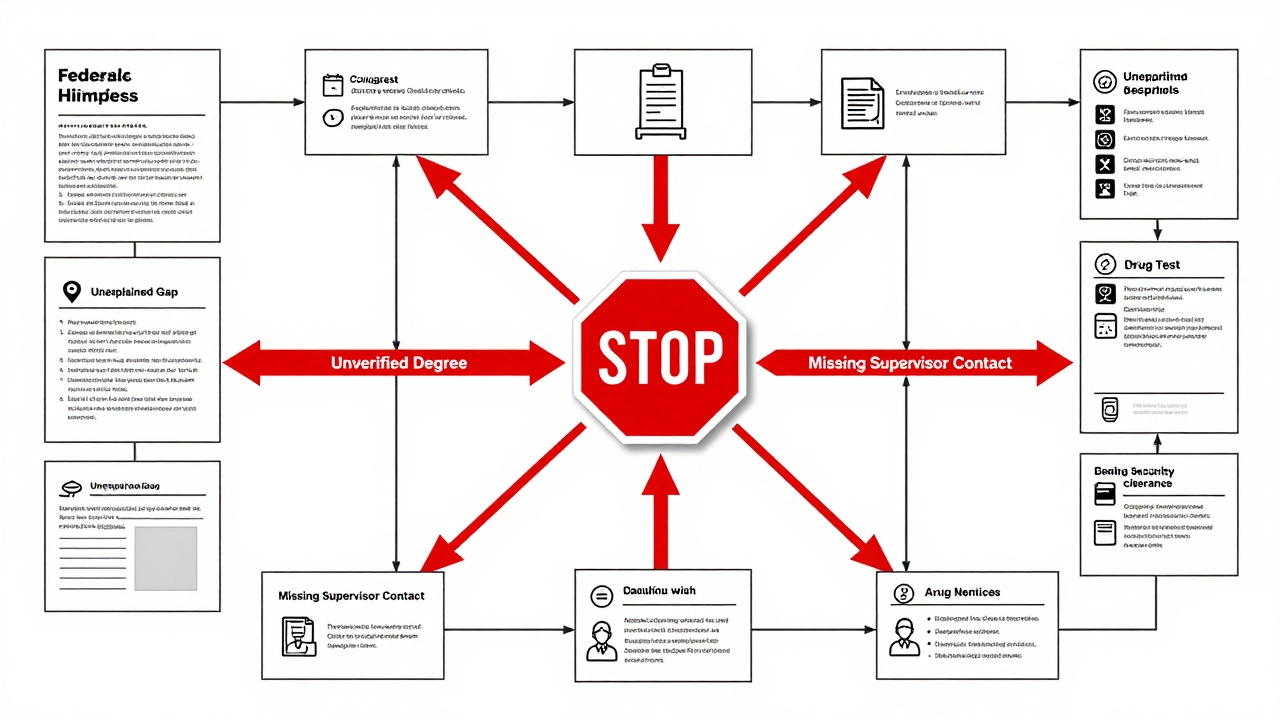
You’d be surprised how many people get rejected because they didn’t fill out the SF-86 form right. This is the Standard Form 86, the National Security Questionnaire. It’s long. It’s detailed. And if you leave a blank, give a vague answer, or skip a job you held for three months in 2018, they’ll pause your application. No warning. No chance to fix it. Just stuck in limbo.
They also check your employment history. If you say you worked at a company from 2019 to 2022 but can’t provide contact info for your supervisor, or if the company went out of business and you have no records, that’s a problem. Federal hiring managers need to verify every job you list. If you can’t prove it, they assume you’re hiding something.
Even your education matters. If you claim a bachelor’s degree but can’t provide transcripts or proof of graduation from an accredited school, you’re out. No exceptions. Online degrees? Fine-if they’re from a recognized institution. But if you got it from a diploma mill, they’ll catch it. The Office of Personnel Management cross-references with the Department of Education’s database.
Immigration status and citizenship
Most federal jobs require U.S. citizenship. Not permanent residency. Not a green card. Citizenship. There are a few exceptions-like some positions at the VA or in certain scientific roles-but they’re rare. If you’re on a visa, waiting for naturalization, or even have dual citizenship without disclosing it, you’ll be disqualified. And yes, they ask. On the SF-86, there’s a whole section asking about foreign citizenship, passports, and family members living abroad. Omitting this isn’t an oversight. It’s fraud.
Even if you’re a naturalized citizen, they’ll dig into your past. Where did you live before coming to the U.S.? Who did you know there? What was your immigration status? If you had a visa violation, overstayed, or were ever denied entry, that’s going to come up. It doesn’t automatically disqualify you, but it adds layers of scrutiny. And if you’re applying for a position requiring a Top Secret clearance? That’s a whole different level of review.
Too many gaps in your resume
Employers in the private sector might overlook a six-month gap. The federal government doesn’t. If you have unexplained gaps of more than 90 days between jobs, you need to account for them. “Took time off to care for a family member” is fine-if you can provide documentation. “Traveled abroad” is okay if you can show passport stamps or receipts. “Didn’t work because I was depressed” might be honest, but it’s not acceptable unless you can prove you received treatment and are cleared to return to work.
They want consistency. They want to know you’re reliable. If you’ve had three short-term gigs in two years with no clear career path, they’ll question your commitment. Federal jobs are long-term. They invest in training. They don’t want to hire someone who might leave after six months.
Applying for the wrong job
It’s easy to think, “I’ve got a degree in biology, so I’ll apply for every science job.” But federal jobs have strict qualification standards. Each position has a detailed announcement with specific education, experience, and certification requirements. If you don’t match them exactly, your application gets auto-rejected by the system.
For example, a job posting might say: “Requires a bachelor’s degree in environmental science AND two years of field experience in water quality monitoring.” If you have the degree but only did lab work, you don’t qualify. Even if you’re clearly capable, the system won’t let you through. You need to match the language. Use the same terms they use. If they say “data analysis,” don’t write “statistical modeling.”
And don’t apply for 50 jobs at once hoping one sticks. That’s a waste of time. Pick one that fits perfectly. Tailor your resume. Highlight the exact keywords from the posting. Submit everything they ask for. Missing one document? That’s an automatic rejection.

Not preparing for the interview
Once you get past the paperwork, you still have to pass the interview. And federal interviews are not like private sector ones. They use structured behavioral questions based on the Core Competencies model. You’ll be asked: “Tell me about a time you handled a conflict with a coworker.” Not “What’s your greatest weakness?”
You need to use the STAR method: Situation, Task, Action, Result. And you need real examples. “I once had to manage a project under pressure” won’t cut it. They want specifics: “In 2022, I led a team of five to process 1,200 FOIA requests within 30 days despite a 40% staff reduction. We reduced backlog by 75% by implementing a digital tracking system.” That’s the kind of detail they’re looking for.
They also test your knowledge of federal policies. If you’re applying for a job in the Department of Homeland Security, you should know what the Homeland Security Act covers. If you’re applying for a role in the IRS, know the basics of tax law. Don’t walk in blind. Research the agency. Know their mission. Know their recent news.
Not following up-or overdoing it
After you submit, you’ll get an automated confirmation. Then silence. Months of it. That’s normal. But if you email every week asking for updates, you’ll be flagged as “high-maintenance.” On the flip side, if you never follow up, your application might get buried.
The sweet spot? Wait 30 days. Then send one polite email to the HR contact listed in the job posting. Ask if there’s any update on the status. That’s it. No demands. No pressure. Just a quiet nudge.
Final thought: It’s not personal
Getting rejected for a federal job doesn’t mean you’re not qualified. It means something in your file triggered a red flag. Maybe it was a small debt. Maybe you forgot to list a part-time job. Maybe you didn’t realize they needed a specific certification.
The fix? Be meticulous. Double-check every form. Document everything. Be honest-even if it hurts. And if you’re denied, request feedback. Federal agencies are required to provide a reason for rejection. Use it. Fix it. Try again.
This isn’t a game of luck. It’s a process. And if you play by the rules, you’ll get through.
Can I get a federal job if I have bad credit?
Bad credit alone doesn’t automatically disqualify you, but it can raise concerns depending on the job. If you’re applying for a financial role, a history of defaults or bankruptcy might be a problem. For most other positions, as long as you can show you’re working to fix it-like setting up a payment plan or completing credit counseling-you can still qualify. The key is transparency. Don’t hide it. Explain it honestly on the SF-86 form.
Do I need to be a U.S. citizen to get any federal job?
Yes, for the vast majority of federal jobs. A few exceptions exist for roles like certain medical or scientific positions at the VA or CDC, where permanent residents may qualify. But even then, you’ll need to pass an enhanced background check. If you’re not a citizen, focus on private sector or contractor roles first. Citizenship is non-negotiable for most federal positions.
How long does the federal hiring process take?
It can take anywhere from 3 months to over a year. Entry-level jobs might move faster-around 60 to 90 days. Jobs requiring security clearances, especially Top Secret, can take 8 to 18 months. The timeline depends on the agency, the clearance level, and how complete your application is. Submitting everything correctly the first time cuts months off the wait.
Can I apply for federal jobs if I’ve been arrested but not convicted?
Yes, but you must disclose it. Arrests-even without conviction-must be reported on the SF-86. The agency will review the circumstances. A single minor arrest from 10 years ago, like a DUI or trespassing, is often overlooked if you’ve shown rehabilitation. Repeated offenses or recent arrests, especially involving drugs or violence, will likely disqualify you. Honesty matters more than perfection.
What if I made a mistake on my application?
If you catch it before the review starts, you can often withdraw and resubmit. Once the background check begins, changing answers becomes much harder. If you realize you left something out after submission, contact the HR office immediately. Admit the error. Provide the correct info. It’s better to be upfront than to be caught lying later. Many applicants get rejected for dishonesty, not for the original mistake.