
There are hundreds of eLearning platforms out there, but not all of them are built for the same kind of learner. Whether you’re a working professional trying to upskill, a student preparing for exams, or a parent looking for structured learning for your teenager, the "best" platform depends entirely on what you need it to do. The truth is, there’s no single winner - just the right fit for your goals.
What makes one eLearning platform better than another?
It’s not about flashy design or big marketing budgets. The best platforms have clear strengths in five key areas: course quality, ease of use, mobile access, certification value, and instructor support. Let’s break them down.
Course quality means real content - not just recycled slides. Look for platforms that hire subject-matter experts, update material regularly, and include hands-on projects. A course on data analysis that only shows PowerPoint slides won’t help you land a job. One that gives you real datasets to clean, analyze, and present? That’s different.
Ease of use is often overlooked. If you have to hunt for the next lesson, reset your password three times, or deal with a clunky video player, you’ll quit. The best platforms make navigation intuitive. You should be able to pick up where you left off without thinking about it.
Mobile access isn’t a bonus anymore - it’s a requirement. People learn on buses, during lunch breaks, or while waiting at the doctor’s office. Platforms that offer downloadable lessons, offline mode, and mobile-optimized apps win here.
Certification value matters if you’re using the course for your career. A certificate from a platform like Coursera or edX that partners with universities or companies like Google and IBM carries weight. A self-made badge from an unknown provider? Not so much.
Instructor support makes the difference between "I got stuck" and "I figured it out." Platforms with active discussion forums, live Q&As, or direct instructor feedback help learners push through tough spots.
The top eLearning platforms in 2026
Here are the platforms that consistently rank highest across these criteria - based on user feedback, course updates, and industry adoption.
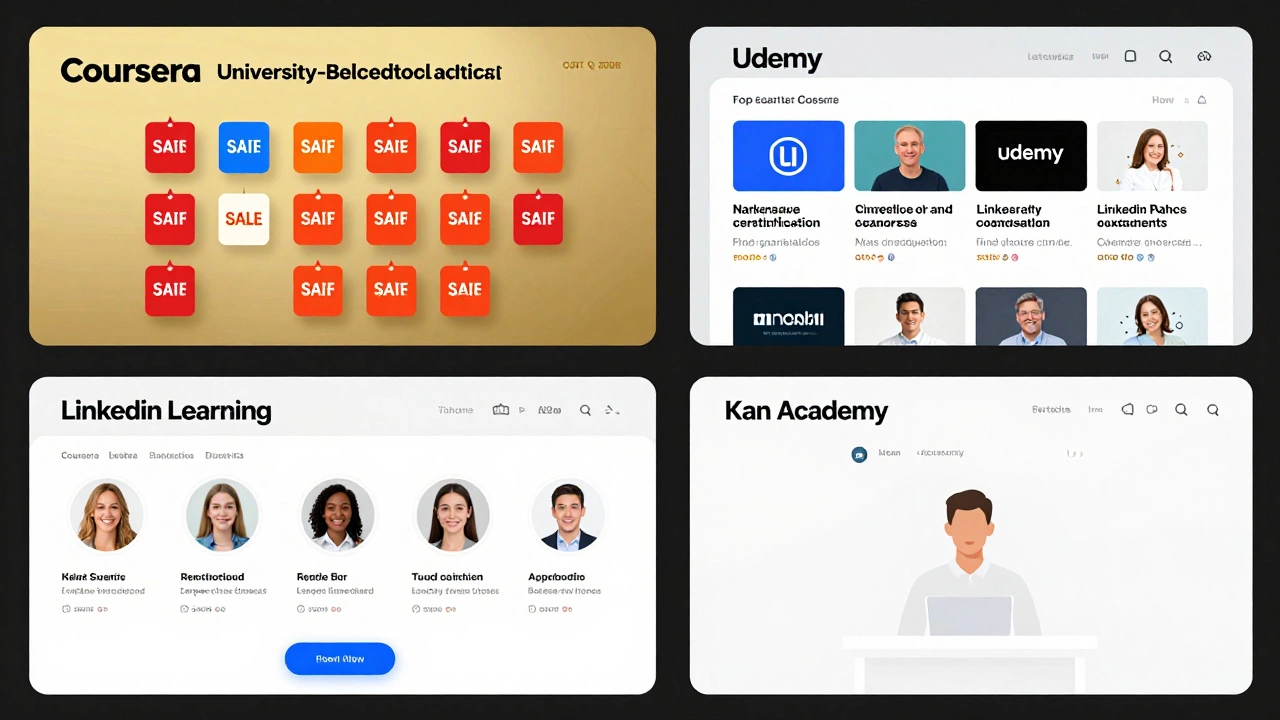
Coursera
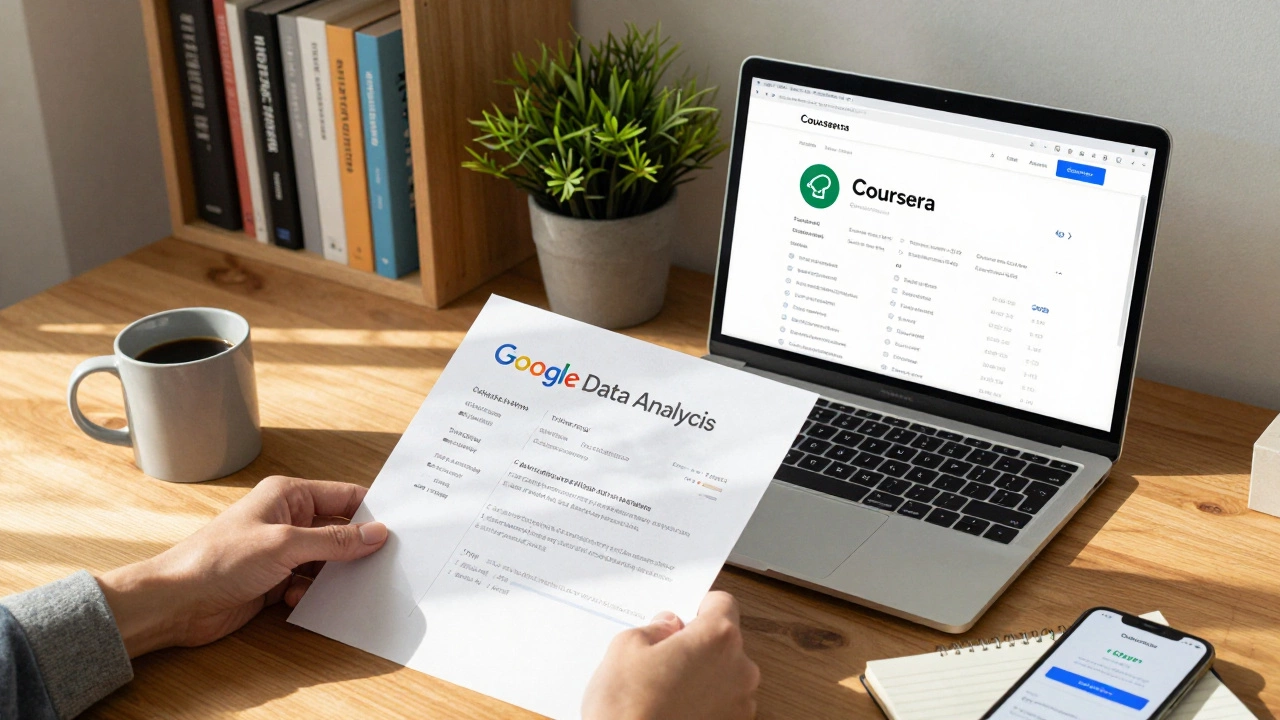
Coursera is the go-to for structured, university-backed learning. It partners with over 300 universities and companies, including Stanford, Yale, and Google. You’ll find full degree programs, professional certificates, and short courses. Most courses include graded assignments and peer-reviewed projects. The standout? The Google Data Analytics Professional Certificate - completed by over 1 million people and accepted by major employers like Deloitte and IBM.
It’s not cheap - individual courses start at $49, and specializations run $39-$79 per month. But if you’re aiming for a promotion or career change, the ROI is real. Coursera also offers financial aid if you qualify.
Udemy
Udemy is the opposite of Coursera in structure. It’s a marketplace. Anyone can create a course. That means quality varies wildly. But it also means you’ll find niche topics you won’t see anywhere else - like "Excel for Real Estate Agents" or "Building a Shopify Store from Scratch."
The big win? Price. Most courses are priced between $10 and $20 during sales (which happen almost weekly). You get lifetime access. No subscriptions. You pay once, you own it.
Watch out for outdated content. Always check the last update date. A course on Python from 2020 might not cover the latest libraries. Look for ones updated in 2025 or later.
edX
Founded by MIT and Harvard, edX is known for academic rigor. It’s ideal if you want to learn like a college student - with problem sets, exams, and deadlines. You can audit most courses for free, but if you want a verified certificate, expect to pay $50-$300.
edX’s MicroMasters programs are especially valuable. These are graduate-level sequences that can count toward a full master’s degree at partner universities. For example, the MicroMasters in Supply Chain Management from MIT can be applied to a full degree at RIT or UMD.
It’s not the most user-friendly interface, but if you’re serious about credentials, edX delivers.
LinkedIn Learning
If you’re in a corporate job or want to build your professional profile, LinkedIn Learning is your best bet. Its library of 16,000+ courses covers everything from leadership to Excel macros to Adobe After Effects.
The magic? It syncs with your LinkedIn profile. When you complete a course, it automatically adds the credential to your profile. Recruiters see it. Hiring managers notice. It’s subtle, but powerful.
It’s subscription-only - $39.99/month or $359/year. But if you’re already on LinkedIn, the integration makes it feel seamless. Many companies also pay for employee access, so check with your HR department.
Khan Academy
Khan Academy is free. And it’s not just for kids. It has full high school and early college courses in math, science, economics, and even computer science. The teaching style is conversational, visual, and patient.
It’s perfect for foundational learning. If you’re struggling with algebra, calculus, or chemistry, Khan Academy’s step-by-step videos will rebuild your confidence. It doesn’t offer certificates, but it’s unmatched for clarity and depth.
Used by over 150 million learners worldwide, it’s the most trusted free platform on the planet.
What kind of learner are you?
Choosing the right platform starts with knowing yourself.
- If you want a recognized credential for your resume → Coursera or edX
- If you’re on a tight budget and need specific skills → Udemy
- If you’re building your professional brand → LinkedIn Learning
- If you’re relearning basics or helping someone else → Khan Academy
Don’t try to find one platform that does everything. Most successful learners use two or three depending on the goal.
What’s missing from most lists?
Many reviews ignore regional platforms that dominate outside the U.S. In India, Unacademy and Byju’s lead in exam prep for competitive tests. In Europe, FutureLearn (partnered with UK universities) is popular for short courses in business and health. In Latin America, Campus Mágico offers Spanish-language courses with local case studies.
If you’re not in the U.S., don’t assume the "top" platforms are right for you. Local platforms often have better language support, culturally relevant examples, and exam alignment.
Red flags to watch out for
Not all platforms are trustworthy. Watch for these warning signs:
- "Guarantee a job after this course" - no legitimate platform can promise employment.
- No instructor bios or credentials listed - if you don’t know who’s teaching, walk away.
- Outdated course materials - check the "Last updated" date. Anything older than 2023 is risky for tech fields.
- Forced upsells - if you’re constantly pushed to upgrade to a "premium" version just to finish a lesson, it’s a trap.
- No refund policy - reputable platforms offer at least a 30-day money-back guarantee.
How to test a platform before committing
Most of these platforms offer free trials or free course audits. Use them.
- Sign up for a free account on 2-3 platforms you’re considering.
- Enroll in one free introductory course on each.
- Ask yourself: Did I finish it? Did I understand it? Would I pay for the next one?
- Check the discussion boards - are instructors responding? Are other learners helpful?
- Look at the mobile app - is it smooth? Can you download lessons?
This takes less than a week. But it saves you hundreds of dollars and months of frustration.
Final advice: Don’t chase the "best" - chase the right fit
The best eLearning platform isn’t the one with the most users or the fanciest website. It’s the one you’ll actually use. If you’re motivated by deadlines, pick Coursera. If you learn best at your own pace, Udemy wins. If you need proof for your boss, LinkedIn Learning delivers. If money’s tight, Khan Academy is your lifeline.
People think learning is about tools. It’s not. It’s about consistency. One hour a day, five days a week, for six months will change your career more than any platform ever could.
Is there a free eLearning platform that’s actually good?
Yes. Khan Academy is the most reliable free platform, especially for math, science, and computer basics. It’s used by schools worldwide and has been updated continuously since 2011. Coursera and edX also let you audit most courses for free - you just won’t get a certificate unless you pay.
Can I get a job after taking an online course?
Not just from taking the course - but from what you do after. Employers care about skills, not certificates. If you complete a Google Data Analytics course on Coursera and then build three real-world projects using the tools you learned, you’ll stand out. The certificate opens the door. Your portfolio walks you through it.
Are certificates from online platforms worth anything?
It depends. Certificates from Coursera, edX, and LinkedIn Learning are recognized because they’re backed by universities or major companies. A certificate from a platform you’ve never heard of? Probably not. Always check if the course partner is a name you recognize - like MIT, IBM, or Google.
Should I pay for a subscription or buy courses individually?
If you plan to take more than 3-4 courses a year, a subscription like LinkedIn Learning or Coursera Plus makes sense. If you only need one or two specific skills, buy individual courses on Udemy. They’re often under $20 during sales. Never pay full price on Udemy - wait for a sale.
Do these platforms work on mobile?
All major platforms have mobile apps - Coursera, Udemy, edX, LinkedIn Learning, and Khan Academy. But not all apps are equal. Test them. Look for features like offline downloads, video speed controls, and progress syncing. If the app crashes often or won’t let you pause videos, find another platform.
What’s the best platform for learning coding?
For beginners, Codecademy and freeCodeCamp are excellent free options with interactive coding. For career-focused learners, Coursera’s Python for Everybody (University of Michigan) and edX’s CS50’s Introduction to Programming with Python (Harvard) are top choices. They include real projects and grading - not just quizzes.
Do I need to be tech-savvy to use these platforms?
No. All major platforms are designed for non-tech users. If you can browse the web or use a smartphone app, you can use them. The hardest part is getting started - not the interface. Most offer onboarding tutorials. Stick with it for 10 minutes. You’ll be fine.